
Finding asbestos in a ceiling tile, pipe wrap, floor tile, siding, or boiler room can stop a project instantly. The next decision matters: the right asbestos abatement contractor helps protect occupants and workers, keeps the job compliant, and prevents a manageable issue from becoming a costly delay.
This is especially important in New England, where older homes, schools, municipal buildings, hospitals, warehouses, and commercial properties may contain legacy asbestos materials. Even if a building looks well maintained, asbestos can still be present behind walls, under flooring, around mechanical systems, or in exterior materials.
According to the U.S. Environmental Protection Agency, asbestos-containing materials are not necessarily dangerous when they are intact and undisturbed. The risk increases when those materials are damaged, cut, sanded, demolished, or removed improperly, releasing microscopic fibers into the air. That is why choosing a qualified contractor is not just a purchasing decision. It is a safety and compliance decision.
Start by understanding what type of asbestos help you need
Before comparing contractors, clarify the problem you are trying to solve. Not every asbestos situation requires immediate removal. In some cases, a qualified professional may recommend management in place, encapsulation, enclosure, selective removal, or full abatement depending on the material, condition, location, and planned work.
The most common scenarios include suspected asbestos discovered before renovation, damaged materials that may be releasing fibers, asbestos found during demolition planning, and asbestos-containing materials that must be removed to access mechanical, plumbing, or structural systems.
Testing and abatement are related, but they are not the same service. Testing identifies whether asbestos is present. Abatement is the controlled process of removing, encapsulating, enclosing, or otherwise addressing asbestos-containing materials under regulated conditions. If you are unsure whether a material contains asbestos, do not disturb it, and do not rely on appearance alone. For example, older ceiling tiles, floor tile mastic, pipe insulation, vermiculite, and siding can all require proper evaluation.
If you are dealing with ceiling materials, this guide to testing ceiling tiles for asbestos explains why visual identification is not enough.
Verify licensing, training, and regulatory knowledge
A trustworthy asbestos abatement contractor should be able to explain what licenses, certifications, notifications, and procedures apply to your project. Requirements vary by state and by project type, and additional rules may apply for commercial buildings, schools, public facilities, and demolition work.
At the federal level, the EPA asbestos NESHAP rules address asbestos during certain renovation and demolition activities. The Occupational Safety and Health Administration also sets worker protection standards for asbestos exposure. In Massachusetts, MassDEP provides guidance on asbestos construction and demolition notifications. Rhode Island projects may involve separate state and local requirements, so the contractor should confirm applicable rules before work begins.
A qualified contractor should not make vague claims about being compliant. They should be ready to discuss the process in plain language, including permits or notifications, containment, waste handling, worker protection, and final documentation.
| What to verify | Why it matters | Strong contractor signal |
|---|---|---|
| State licensing and worker certifications | Asbestos work is regulated and requires trained personnel | The contractor can provide current documentation before work starts |
| Insurance coverage | Abatement carries health, property, and liability risks | Coverage is active and appropriate for asbestos-related work |
| Regulatory familiarity | Local and federal rules affect schedule, notifications, and disposal | The contractor explains which requirements apply to your property |
| Similar project experience | Homes, schools, commercial sites, and municipal facilities have different constraints | The contractor can describe comparable projects and likely challenges |
| Written work plan | A clear plan reduces confusion and risk | The scope, containment, disposal, and schedule are documented |
Look for a site-specific work plan, not a generic promise
The best asbestos abatement contractor will not treat every project the same. Removing floor tile from a vacant basement is different from abating pipe insulation in an active school or handling asbestos-containing materials during a structural demolition. The work plan should reflect the property, the material, the occupancy status, and the sequencing of other trades.
A site-specific plan should explain what materials are being addressed, how the work area will be isolated, how dust and fiber release will be controlled, how HVAC systems and adjacent spaces will be protected, how waste will be packaged and transported, and what clearance process will be used when required or specified.
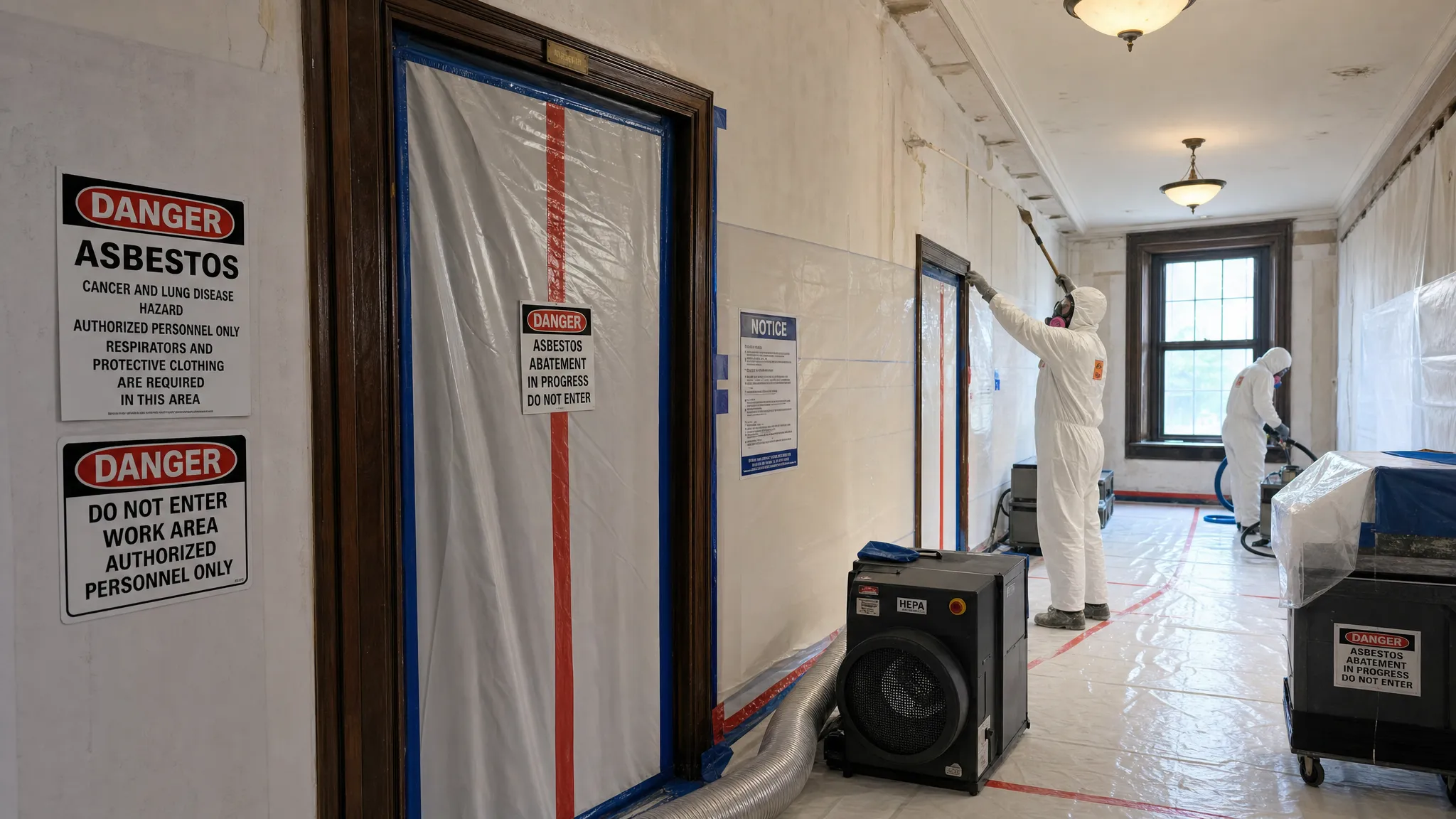
Pay attention to how the contractor discusses containment. Depending on the project, this may involve critical barriers, plastic sheeting, negative air machines, HEPA filtration, decontamination areas, signage, and restricted access. The details matter because asbestos risk is not limited to the material being removed. Poor containment can spread contamination into spaces that were previously unaffected.
A professional contractor should also ask you questions. They should want to know whether the building is occupied, whether utilities need to remain active, whether other contractors are scheduled, whether there are sensitive occupants, and whether the project is tied to a real estate closing, tenant turnover, insurance claim, renovation, or demolition deadline.
Compare estimates by scope, not just price
It is reasonable to request more than one estimate, but the lowest number is not always the best value. A low bid may omit important items such as containment, disposal, air monitoring coordination, final cleaning, documentation, or schedule constraints. If one estimate is dramatically lower than the others, ask what is included and what is excluded.
A complete asbestos abatement estimate should be specific enough for you to understand the work. It should identify the materials involved, approximate quantities when applicable, areas of the building affected, access needs, containment approach, waste disposal expectations, project timeline, and any assumptions that could change the cost.
| Estimate component | Why it affects the project |
|---|---|
| Material type and location | Pipe insulation, flooring, siding, ceiling materials, and vermiculite require different methods |
| Quantity and accessibility | Hard-to-reach materials can increase labor, containment, and schedule needs |
| Occupancy status | Work in occupied buildings may require phasing, off-hours work, or additional protections |
| Required notifications | Regulatory waiting periods or filings can affect start dates |
| Disposal requirements | Asbestos waste must be handled, labeled, transported, and disposed of properly |
| Post-abatement clearance | Final visual inspections or air clearance may be required or requested |
| Related demolition or restoration | Coordination with demolition, carpentry, painting, or rebuilding can affect sequencing |
A good estimate is not necessarily the longest document, but it should leave you with fewer questions, not more.
Ask how the contractor handles documentation
Documentation is one of the clearest differences between a professional abatement company and a risky operator. If a contractor cannot clearly explain the paperwork you will receive, that is a concern.
Depending on the project, documentation may include licensing information, insurance certificates, survey or testing reports, written scope of work, regulatory notifications, waste shipment records, daily logs, clearance results, and closeout documentation. For commercial, institutional, municipal, or real estate-related projects, these records can be essential later.
This is also important for property owners who plan future renovations. If asbestos is removed from one area but remains in another, accurate records help avoid confusion when new work is planned. For facilities that require ongoing monitoring, regular asbestos re-inspection surveys can be part of a long-term management strategy. Banner has covered this topic in more detail in its article on asbestos re-inspection surveys.
Consider experience with your property type
Asbestos abatement in a single-family home is not the same as abatement in a university, hospital, manufacturing facility, wastewater treatment plant, office building, or municipal property. Each environment has different access issues, stakeholder expectations, schedule pressures, and safety requirements.
For residential projects, the contractor should explain how the work area will be separated from living spaces, how belongings should be handled, whether occupants need to leave during work, and what the home will look like when the project is complete.
For commercial and institutional projects, communication and coordination become even more important. A contractor may need to work around building operations, tenants, students, patients, public access, security procedures, or other trades. In these settings, experience with phasing and project documentation can be just as important as removal technique.
Banner Environmental Services has completed asbestos abatement and selective demolition work in active institutional settings, including projects such as Bridgewater State University’s Tillinghast Hall and Roger Williams University. Those kinds of projects show why planning, containment, compliance, and coordination all need to work together.
Watch for red flags before you sign
Some warning signs are obvious, while others only appear when you ask a few direct questions. If a contractor is evasive about licensing, discourages testing, minimizes containment, or pressures you to start immediately without documentation, slow down.
Red flags include:
- The contractor cannot provide proof of current asbestos licensing, training, or insurance.
- The estimate is vague and does not identify the materials or areas involved.
- The contractor says testing is unnecessary even though the material is unknown.
- The contractor plans to remove or disturb materials without discussing containment.
- There is no clear plan for waste packaging, transport, or disposal.
- The contractor suggests that a general demolition crew can handle asbestos without proper controls.
- The contractor will not explain whether notifications, permits, or clearance steps apply.
- The contractor recommends removal of intact material without explaining why removal is necessary.
A reputable contractor will not be offended by careful questions. In fact, they should welcome them, because careful questions usually lead to a safer, smoother project.
Do not overlook communication and scheduling
Many asbestos problems become stressful because they are discovered at the wrong time: just before a renovation, during a property sale, after water damage, or in the middle of a demolition schedule. The contractor you choose should communicate clearly about lead times, regulatory requirements, access, setup, work duration, and closeout.
Ask who your main contact will be. Ask how schedule changes are handled. Ask what you need to do before work begins, such as clearing rooms, coordinating utilities, notifying occupants, or pausing other trades. If you manage a commercial or institutional building, ask how the contractor handles stakeholder communication and site access.
A contractor with strong communication can prevent small issues from becoming major disruptions. This is especially valuable when asbestos abatement is part of a larger scope that also includes demolition, water damage cleanup, mold remediation, carpentry, painting, or commercial cleaning.
Think beyond removal: what happens after abatement?
Once asbestos-containing material has been removed or controlled, the next step may be renovation, rebuilding, demolition, cleaning, or restoration. Choosing a contractor that understands the full project context can make handoffs easier.
For example, if asbestos floor tile must be removed before interior demolition, the abatement schedule needs to align with demolition crews. If asbestos is discovered after water damage, cleanup and drying may also require careful sequencing. If ceiling materials are removed, carpentry or painting may be part of returning the space to use.
Banner Environmental Services provides asbestos testing and removal, mold remediation, water damage cleanup, demolition, vermiculite removal, black mold removal, commercial cleaning, carpentry, and painting services for residential and commercial customers. For property owners and facility teams in Rhode Island, Massachusetts, and the broader New England region, that range of services can help simplify planning when asbestos is only one part of a larger project.
A practical decision framework
If you are comparing several contractors, use a simple framework before choosing. The right asbestos abatement contractor should score well across safety, compliance, clarity, experience, and fit for your property.
| Decision factor | What you want to hear |
|---|---|
| Safety approach | The contractor can explain containment, worker protection, and access control in plain language |
| Compliance process | The contractor knows which notifications, standards, and disposal rules apply |
| Scope clarity | The proposal identifies materials, locations, exclusions, and assumptions |
| Project fit | The contractor has experience with similar buildings or project conditions |
| Documentation | The contractor provides closeout records and required paperwork |
| Communication | You know who will manage the project and how updates will be shared |
| Value | The estimate is competitive and complete, not simply the lowest number |
Choosing the right contractor may take a little more time upfront, but it can save significant time, cost, and risk once work begins.
Frequently Asked Questions
How do I know if I need an asbestos abatement contractor? You may need an asbestos abatement contractor if suspected asbestos-containing materials are damaged, will be disturbed during renovation or demolition, or must be removed to complete other work. Start with proper inspection or testing before disturbing the material.
Can a general contractor remove asbestos? A general contractor should not remove asbestos unless properly licensed, trained, and authorized for asbestos work under applicable regulations. Many renovation and demolition contractors bring in a licensed asbestos abatement contractor for this reason.
Is asbestos always required to be removed? No. If asbestos-containing material is intact, in good condition, and unlikely to be disturbed, management in place may be appropriate. A qualified professional can help determine whether removal, encapsulation, enclosure, repair, or monitoring is the right approach.
What documents should I ask for before work starts? Ask for proof of licensing, insurance, worker training, written scope of work, applicable notifications or permits, and a clear explanation of containment and disposal procedures. For some projects, you should also discuss clearance testing or final inspection documentation.
Why do asbestos abatement estimates vary so much? Estimates can vary because contractors may include different assumptions about containment, labor, access, disposal, clearance, phasing, and related demolition or restoration. Compare the full scope, not only the final price.
How long does asbestos abatement take? The timeline depends on the material, quantity, building conditions, regulatory requirements, containment needs, and whether the property is occupied. A small residential project may be very different from a phased commercial or institutional project.
Need help choosing the right next step?
If you suspect asbestos in a home, business, school, municipal facility, or renovation project, do not disturb the material until it has been properly evaluated. Banner Environmental Services provides licensed environmental remediation, including asbestos testing and removal, for residential and commercial customers across Rhode Island, Massachusetts, and New England.
For a clear scope, safe process, and free project estimate, contact Banner Environmental Services.