
What is Asbestos Abatement?
What is asbestos abatement is one of the most important questions any building owner can ask before starting a renovation, demolition, or even routine maintenance on an older property.
Here’s the short answer:
Asbestos abatement is the regulated process of controlling, removing, encapsulating, or otherwise managing asbestos-containing materials (ACM) in a building to prevent dangerous fibers from becoming airborne and harming people.
It covers a range of services, including:
- Inspection and testing to confirm the presence of ACM
- Removal of materials containing more than 1% asbestos
- Encapsulation or enclosure when full removal isn’t the right option
- Air monitoring and clearance testing to verify the space is safe
- Proper disposal at licensed hazardous waste facilities
Asbestos is a naturally occurring fibrous mineral that was widely used in building materials throughout the 20th century. It was prized for its heat resistance and durability. But when those materials are disturbed, microscopic fibers are released into the air — and breathing them in can cause serious, life-threatening diseases.
The EPA banned all new uses of asbestos in 1989. Still, it can be found in almost all buildings constructed before that date, making abatement a critical concern for millions of property owners across the U.S.
I’m Stephen Wenzel, Co-Owner and Executive Vice President of Banner Environmental Services, and with over 25 years of hands-on experience in asbestos abatement, pre-demolition surveys, and hazardous material remediation, I’ve seen what proper — and improper — handling of what is asbestos abatement looks like in practice. In this guide, I’ll walk you through everything you need to know to protect your building, your occupants, and your compliance standing.
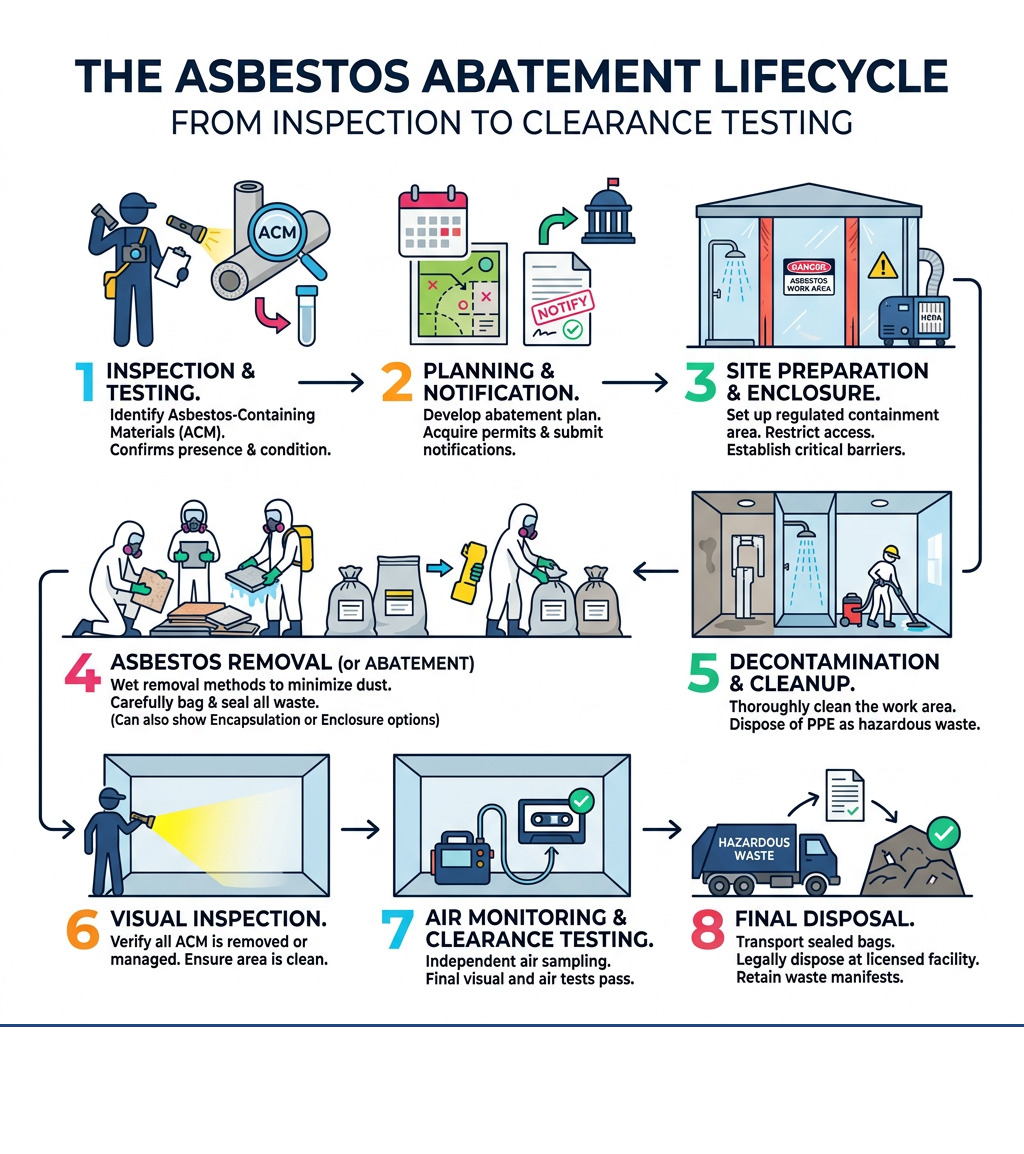
To dive deeper into Asbestos Abatement, we have to look at it as an umbrella term. While many people use “abatement” and “removal” interchangeably, they aren’t exactly the same. According to the legal definition of abatement, it refers to any set of procedures designed to control the release of asbestos fibers from asbestos-containing materials. This includes removal, but it also covers encapsulation, enclosure, and even specialized repair.
At its core, the goal of [what is asbestos abatement] is risk mitigation. We are dealing with a material that is perfectly safe when left alone and in good condition, but becomes a deadly hazard the moment it is sawed, scraped, or crushed. Whether you are in Boston, MA, or Providence, RI, the regulatory compliance requirements remain strict because the stakes are so high. Environmental remediation ensures that the air we breathe in our homes, schools, and offices remains free of microscopic carcinogens.
Understanding the Process of What is Asbestos Abatement
When we talk about Professional Asbestos Removal How It Works, we are looking at a highly choreographed safety operation. It’s not as simple as throwing on a mask and pulling up floor tiles.
The process begins with site preparation. We establish “regulated areas” that are strictly off-limits to unauthorized personnel. These areas are sealed using heavy-duty polyethylene sheeting and duct tape to create airtight containment barriers. To ensure no fibers escape if a seal is breached, we use “negative air pressure” machines. These units pull air from the work area, pass it through high-efficiency particulate air (HEPA) filtration—which traps 99.97% of particles as small as 0.3 micrometers—and vent the clean air outside. This creates a vacuum effect, ensuring that air always flows into the work zone, never out of it.
Choosing the Right Method for What is Asbestos Abatement
Not every project requires full Asbestos Abatement Removal. Depending on the condition of the material and the future plans for the building, we might recommend:
- Encapsulation: Coating the asbestos with a sealant that binds the fibers together or creates a protective “shell” over the material.
- Enclosure: Building a permanent, airtight barrier around the asbestos (like a new wall or ceiling).
- Repair: Fixing small areas of damaged insulation to prevent fiber release.
However, if you are planning a renovation or demolition, removal is usually the only legal and practical option. Cutting corners here is never worth it. The Improper Asbestos Removal risks are severe—not just for your health, but for your wallet. In places like New York City, penalties for non-compliance can range from $1,200 to $10,000 per infraction. In New England, state agencies like MassDEP and the New Hampshire Department of Environmental Services (NHDES) are equally vigilant.
Health Risks and Common Locations of Asbestos
Why all the fuss? It comes down to biology. Asbestos fibers are shaped like tiny needles. When inhaled, they lodge themselves deep in the lung tissue or the lining of the chest and abdomen. Because they are chemically resistant, the body cannot break them down.
Over time, these fibers cause inflammation and scarring. The scary part is the latency period; it can take 10 to 50 years after exposure for symptoms to appear. This is why Mesothelioma symptoms and causes are often diagnosed in older adults who worked in construction or shipyards decades ago. Other serious conditions include Asbestosis research, a chronic lung disease, and various forms of lung cancer.
There is no “safe” level of asbestos exposure. Even a single project involving Asbestos-Containing Materials (defined as any material containing >1% asbestos) can release millions of fibers if handled incorrectly.
Where Asbestos Is Found in Buildings
If your building was constructed before 1989, there is a very high probability it contains asbestos. It was the “miracle mineral” used in over 3,000 different building products. Common locations include:
- Insulation: Specifically vermiculite or “blown-in” attic insulation. Knowing How to Tell if Insulation is Asbestos usually requires a lab test, as it can look like ordinary gray or silver pebbles.
- Flooring: 9×9 inch vinyl floor tiles and the black mastic adhesive used to glue them down are classic examples.
- Ceilings: The infamous “popcorn” or acoustic ceilings.
- Exterior: Roofing shingles and cement siding (often called “transite”).
- Mechanical Systems: Thermal system insulation (TSI) found on pipes, boilers, and ducts.
Methods and Classifications of Abatement Work
To manage these materials, the industry distinguishes between friable and non-friable asbestos.
- Friable: This material can be crumbled or reduced to powder by simple hand pressure when dry. Examples include pipe insulation and sprayed-on fireproofing. This is the most dangerous form because it releases fibers easily.
- Non-Friable: These materials are “bonded” with a hardening agent like cement or vinyl. Think of floor tiles or roofing. They only become dangerous (and “friable”) if they are sanded, ground, or broken.
During [what is asbestos abatement], we use “amended water”—water mixed with surfactants (like soap)—to saturate the material. Wet asbestos cannot fly away, making it much safer to handle. For small sections of pipe, we might use “glovebag” techniques, which involve a sealed plastic bag with built-in gloves that allows a technician to strip the insulation without exposing the room to fibers.
OSHA Work Classifications
The Occupational Safety and Health Administration (OSHA) sets the gold standard for worker safety. Under OSHA Asbestos Standard 1926.1101, asbestos work is divided into four classes:
- Class I: The most hazardous. Involves removing TSI (pipe/boiler insulation) and surfacing ACM.
- Class II: Removal of ACM that is not TSI, such as floor tiles, roofing, or siding.
- Class III: Repair and maintenance work where ACM is likely to be disturbed.
- Class IV: Custodial work where employees clean up debris or dust that may contain ACM.
OSHA also sets the Permissible Exposure Limit (PEL) at 0.1 fiber per cubic centimeter (f/cc) of air as an eight-hour time-weighted average. Our goal is always to keep levels far below that limit.
Legal Requirements and Professional Standards
You cannot simply wake up and decide to remove asbestos today. In most New England states, including Massachusetts and New Hampshire, you must provide a 10-day notification to state environmental agencies before starting a major abatement or demolition project.
Before any work begins, an Asbestos Abatement Survey and Asbestos Abbestos Abatement Testing must be performed by a certified inspector. This survey identifies exactly what materials contain asbestos and where they are located.
Once the work is done, “air clearance testing” is mandatory. An independent laboratory—which should have ELAP (Environmental Laboratory Approval Program) accreditation—samples the air to ensure it meets safety standards before the containment barriers are taken down and the public is allowed back in.
Hiring Certified Professionals
When it comes to [what is asbestos abatement], who you hire matters. You should always look for:
- Licensed Contractors: Ensure they are licensed in your specific state (e.g., MA, RI, NH).
- Certified Investigators: These pros conduct the initial What is an Asbestos Survey.
- Clean History: You can often request violation histories from state agencies to ensure your contractor follows the law.
- Insurance: They must carry specific pollution occurrence insurance.
Doing it the “wrong” way isn’t just a health risk; it’s a legal nightmare. We always emphasize the Asbestos Removal Right Wrong distinction to our clients. Doing it right means following every EPA and OSHA protocol to the letter.
Frequently Asked Questions about Asbestos Abatement
How much does asbestos abatement cost?
While we don’t provide specific quotes without a site visit, several factors influence the price. These include the total square footage of the material, the “friability” (friable material costs more to handle), the accessibility of the area (crawlspaces vs. open rooms), and disposal fees at licensed hazardous waste sites. Because the work is so labor-intensive and requires expensive PPE and filtration equipment, it is naturally more costly than standard demolition.
Can I remove asbestos myself?
In some states, like New Hampshire, homeowners living in a single-family dwelling are technically allowed to perform their own abatement. However, we strongly advise against it. DIY abatement often leads to Improper Asbestos Removal, which can contaminate your entire HVAC system and every soft surface in your home with microscopic fibers that you cannot see or smell. Without specialized HEPA vacuums and negative air machines, you are essentially spreading a carcinogen throughout your living space.
How is asbestos waste disposed of?
You can’t just put asbestos in your curbside trash. Asbestos Abatement Disposal involves double-bagging the waste in 6-mil thick plastic bags or placing it in leak-tight containers. Each container must have a hazardous waste label. The waste must then be transported to a licensed landfill that is authorized to accept asbestos, accompanied by a waste shipment manifest.
Conclusion
Understanding what is asbestos abatement is the first step toward a safer building project. At Banner Environmental Services, we bring over 25 years of experience to every job site across New England. From our headquarters in Massachusetts to our active projects in Rhode Island, New Hampshire, Vermont, and Maine, our mission is to provide Pain Free Abatement that keeps you in total compliance with OSHA and EPA regulations.
Whether you are managing a commercial office in Boston or renovating a historic home in Providence, our licensed and professional team is here to help. Don’t leave your health or your property’s safety to chance. Contact us today for Professional Asbestos Abatement Services you can trust.