
Commercial Property Mold Is a Serious Problem — Here’s What to Do
Commercial property mold is one of the most urgent environmental hazards a building owner or manager can face. Here’s a quick overview of what you need to know:
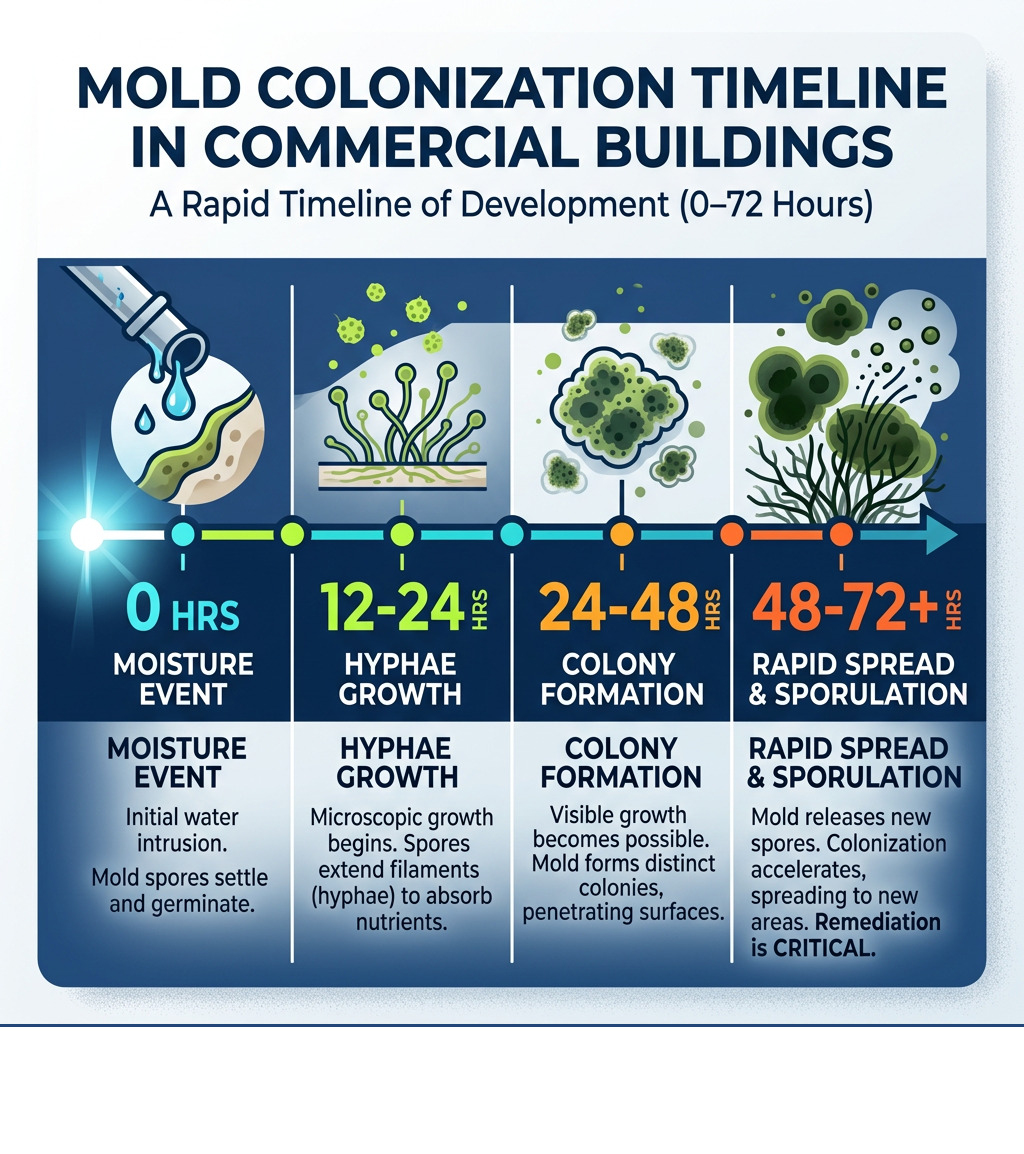
- It grows fast. Mold can begin colonizing within 24–48 hours after moisture contacts organic materials like drywall, carpeting, or ceiling tiles.
- It hides well. In large commercial buildings, mold often develops inside HVAC ducts, wall cavities, and ceiling voids — long before you see or smell anything.
- It carries real consequences. From employee health complaints and tenant disputes to OSHA violations and insurance claim denials, the risks go far beyond cosmetic damage.
- DIY is not enough. For commercial buildings, certified professional remediation is required to safely contain and eliminate mold in compliance with EPA and OSHA guidelines.
- Act within 48–72 hours. If moisture is present and unaddressed, mold spreads rapidly — making early action the single most important step.
Mold doesn’t just appear out of nowhere. It needs moisture, warmth, and something organic to feed on — and commercial buildings provide all three in abundance. Leaky roofs, HVAC condensation, burst pipes, and poor ventilation all create the conditions mold needs to thrive. In New England’s climate, where humidity and seasonal temperature swings are a constant reality, commercial properties face elevated risk year-round.
What makes this especially challenging is the scale and complexity of commercial buildings. Interconnected HVAC systems, shared plumbing chases, and large floor plans mean mold can spread far from its original source — sometimes affecting multiple floors or tenant spaces before anyone notices.
I’m Stephen Wenzel, Co-Owner and Executive Vice President of Banner Environmental Services, with over 25 years of hands-on experience in commercial property mold remediation, containment strategy, and EPA/OSHA-compliant environmental services across Massachusetts, Rhode Island, and Greater New England. In this guide, I’ll walk you through exactly how to identify, remediate, and prevent mold in your commercial property — step by step.
Understanding the Causes and Signs of Commercial Property Mold
When it comes to commercial property mold, we like to say that moisture is the “uninvited guest” that never knows when to leave. If you provide a damp environment and a food source—like the paper facing on drywall or the organic fibers in ceiling tiles—mold will move in rent-free and start a family within two days.
The primary driver is almost always water. Whether it’s a slow-drip leak in a mechanical room or high humidity in a basement, moisture is the catalyst. According to OSHA guidelines on moisture and mold, controlling indoor moisture is the only way to truly manage mold growth. Once that growth starts, you aren’t just looking at a cleaning job; you’re looking at Mold Remediation to ensure the spores don’t just relocate to the next floor.
Common Sources of Moisture in Large Buildings
In the large, complex structures we see in cities like Boston, MA or Providence, RI, moisture sources are often systemic. We frequently encounter:
- HVAC Condensation: If an HVAC system is improperly sized or poorly maintained, it can become a literal mold factory. Condensation in the drain pans or dampness in the fiberglass duct lining provides the perfect nursery for spores.
- Capillary Action: Moisture can actually “wick” upward through porous building materials like concrete or brick. This is common in older New England masonry.
- Roof and Building Envelope Failures: Ice dams in New Hampshire or heavy coastal rains in New Bedford, MA can force water into roof systems and behind siding.
- Poor Drainage: If the landscaping around your building doesn’t slope away from the foundation, you’re essentially inviting a Commercial Mold Remediation specialist to your door.
Identifying Hidden Commercial Property Mold
Mold is a master of hide-and-seek. In a commercial setting, it rarely starts on the front lobby wall where everyone can see it. Instead, it prefers the “backstage” areas:
- Musty Odors: That “old basement” smell is actually the off-gassing of mold (called microbial volatile organic compounds). If you smell it, the mold is there, even if you can’t see it.
- Ceiling Tiles: Discolored or sagging tiles are a flashing neon sign for a roof or pipe leak.
- Wall Cavities and Pipe Chases: Interconnected plumbing lines create “vertical highways” for moisture and spores to travel between floors.
- Elevator Shafts: These are often the most humid parts of a building and can act as chimneys, pulling mold spores from the basement to the penthouse.
If you suspect growth but can’t find the source, it’s time for Mold Remediation: Inspection & Testing to locate the colonies before they become a building-wide crisis.
The High Stakes: Health Risks and Business Liability
In a residential home, mold is a personal problem. In a commercial space, it’s a professional, legal, and financial liability. The stakes are simply higher because you are responsible for the well-being of dozens, hundreds, or even thousands of occupants.
| Feature | Residential Mold | Commercial Property Mold |
|---|---|---|
| Occupant Density | Low (Family units) | High (Employees, customers, tenants) |
| Air Distribution | Simple (Single HVAC) | Complex (Interconnected zones/ducts) |
| Regulatory Oversight | Minimal | High (OSHA, EPA, Health Dept) |
| Liability Risk | Personal health | Lawsuits, workers’ comp, lease breaks |
| Structural Impact | Localized | Systemic (can affect building value) |
Certain molds, such as Stachybotrys chartarum (black mold), produce mycotoxins that can lead to severe health issues. Other common types like Aspergillus can be particularly dangerous for individuals with compromised immune systems. For more on the standards required in public spaces, see the Health risks and air quality in public buildings guidelines. If you find these toxic varieties, you must undergo professional Black Mold Removal immediately.
Impact on Occupant Health and Productivity
When commercial property mold takes hold, your bottom line suffers through your workforce. Common symptoms include:
- Increased employee absenteeism due to respiratory issues or “Sick Building Syndrome.”
- Triggers for asthma attacks and allergic reactions (sneezing, watery eyes, skin rashes).
- Persistent headaches and fatigue among staff.
- Tenant complaints that can lead to broken leases and high vacancy rates.
We’ve seen Mold issues turn a productive office into a ghost town in a matter of weeks. It’s not just about the “ick” factor; it’s about the physical health of the people who keep your business running.
Legal and Financial Consequences for Property Owners
The financial fallout from mold isn’t just the cost of the cleanup. It’s the “hidden” costs that really hurt:
- OSHA Compliance: Failing to provide a safe, mold-free working environment can lead to significant fines and citations.
- Insurance Exclusions: Many commercial policies have specific “mold exclusions.” If you didn’t address a water leak within 48-72 hours, your Commercial property insurance and mold coverage might not pay a dime.
- Tenant Lawsuits: If a tenant can prove that their health issues or business interruptions were caused by your negligence in handling a mold problem, the legal fees can be staggering.
- Property Value: A building with a history of systemic mold issues is much harder to sell or refinance.
Professional Remediation vs. DIY: Why Scale Matters
We often get asked, “Can’t my janitorial crew just wipe this down with some bleach?” The short answer is: No. The long answer is: Please, definitely don’t do that.
Bleach often only kills the surface mold, leaving the “roots” (hyphae) intact inside porous materials like drywall. Even worse, scrubbing mold without proper containment just launches millions of spores into the air, where your HVAC system will happily distribute them to every other room in the building.
The EPA suggests that if a moldy area is larger than 10 square feet (roughly a 3×3 patch), you should not attempt to clean it yourself. In a commercial setting, you’re almost always dealing with more than 10 square feet once you factor in the mold hiding behind the walls. For businesses in the hub, Commercial Mold Remediation Boston services are essential to handle the high-density requirements of the city.
When to Call a Professional for Commercial Property Mold
You should pick up the phone and call a specialist if you notice:
- Visible Black Patches: Especially if they appear on porous materials or near HVAC vents.
- Persistent Moisture: Standing water or high humidity that won’t go away despite your best efforts.
- Recurring Odors: If the “musty” smell returns a few days after cleaning, the source is still active.
- Health Department Intervention: If a tenant has reported the building to local health authorities, you need a certified professional to document the Mold Remediation: Removal & Abatement process for legal protection.
The Professional Remediation Process
When we step onto a commercial site, we follow a rigorous, scientific protocol to ensure the mold is gone for good:
- Moisture Mapping: We use moisture meters and thermal imaging cameras to find exactly where the water is hiding inside your walls without tearing them down first.
- Containment: We set up heavy-duty plastic barriers and use negative air pressure machines. This ensures that while we are cleaning, no spores can escape into the rest of the building.
- HEPA Filtration: We use industrial-grade air scrubbers with HEPA filters to “wash” the air and remove microscopic spores.
- Removal and Cleaning: Contaminated materials that can’t be saved (like sodden drywall) are removed. Everything else is treated with antimicrobial solutions.
- Dry-Fogging: In some cases, we use a dry-fogging technique to reach spores that may be lingering in hard-to-reach areas like high ceilings or ductwork.
- Verification: We don’t just say it’s clean; we prove it. You want to Don’t Just Remove Mold, Remediate It so that the root cause is solved.
Prevention Strategies and Maintenance Best Practices
The best way to deal with commercial property mold is to never let it start. In New England, this is a 365-day-a-year job. From the humid summers in Warwick, RI to the damp spring thaws in Manchester, NH, your building is constantly under threat.
Here is our “Golden Rule” list for mold prevention:
- Humidity Control: Keep your indoor relative humidity between 30% and 50%. Anything over 60% is an open invitation for mold. Use commercial dehumidifiers in basements and mechanical rooms.
- HVAC Maintenance: Change your filters regularly and ensure that condensate pans are draining properly. A clogged drain line is the #1 cause of office mold.
- Roof and Gutter Inspections: In New Hampshire, we disposed of over 266,000 tons of construction debris in 2022—much of it from water-damaged buildings. Don’t let your roof be part of next year’s stats. Clean your gutters and check for flashing leaks after every major storm.
- Immediate Water Response: If a pipe bursts or a window leaks, you have a 48-hour window to dry it out before mold takes hold. Don’t wait for the weekend.
- Professional Cleaning: Regular Commercial Cleaning helps remove the dust and organic matter that mold uses as food.
- Basement Vigilance: Basements are the most common ground zero for mold. Stay on top of Basement Mold Remediation: Dangers, Treatments & Costs to prevent issues from rising into the upper floors.
Frequently Asked Questions about Commercial Property Mold
How quickly does mold spread in a commercial building?
Mold can begin to grow within 24 to 48 hours of a water event. Because commercial buildings often have interconnected HVAC systems and shared wall cavities, a small colony in a basement can spread spores throughout the entire building via the air ducts in just a few days. If moisture issues aren’t addressed within 72 hours, you are almost guaranteed a significant mold problem.
Is visible mold required for a professional inspection?
Absolutely not. In fact, most of the most “dangerous” mold cases we handle involve hidden mold. If your employees are complaining of respiratory issues, or if there is a persistent musty odor, you should have an inspection. We use thermal imaging and air quality testing to find mold that is tucked away behind drywall or inside insulation where the naked eye can’t see it.
Does commercial property insurance cover mold remediation?
It depends on the “trigger” of the mold. Most policies will cover mold if it is the direct result of a “covered peril,” such as a sudden pipe burst or fire-fighting efforts. However, if the mold is caused by long-term neglect, like a roof leak that was ignored for months or poor ventilation, insurance companies will often deny the claim under “maintenance exclusions.” Always document your maintenance and act quickly to improve your chances of a successful claim.
Conclusion
Dealing with commercial property mold can feel overwhelming, but you don’t have to face it alone. Whether you’re managing a retail store in Framingham, a high-rise in Boston, or a warehouse in Nashua, the key is fast, professional action.
At Banner Environmental Services, we bring over 25 years of experience to every job. We are WBE and DCAMM certified, ensuring that every remediation project we undertake meets the strictest OSHA and EPA compliance standards. Our team is licensed and ready to serve you across Massachusetts, Rhode Island, New Hampshire, Connecticut, Vermont, and Maine.
Don’t let a small leak turn into a major liability. Protect your property, your tenants, and your peace of mind. Contact our experts for Commercial Mold Remediation today for a professional assessment and a clear path to a mold-free environment.