
What You Need to Know About Asbestos Abatement Laws (Quick Answer)
Asbestos abatement laws govern how asbestos-containing materials (ACM) must be identified, managed, removed, and disposed of in the United States. Here is a fast overview of the key rules:
- EPA NESHAP under the Clean Air Act covers demolition and renovation notice requirements, emission controls, and asbestos waste handling.
- AHERA under TSCA covers asbestos inspections and management plans in schools.
- OSHA 29 CFR 1926.1101 covers worker exposure limits, personal protective equipment, training, and asbestos work classifications.
- TSCA Section 6(a) covers the 2024 chrysotile asbestos ban, including phased compliance timelines.
- State agencies may impose additional licensing, notification, and disposal rules that vary by state.
Key thresholds to know:
- ACM threshold: Any material with more than 1% asbestos is regulated
- OSHA PEL: No more than 0.1 fibers per cubic centimeter over an 8-hour workday
- NESHAP notification: Required 10 days before most demolitions or renovations
- AHERA reinspections: Required every 3 years in schools
Navigating these rules isn’t simple. Federal agencies like the EPA and OSHA set the floor, but states often layer on stricter requirements. Missing a step — a notification, a clearance test, a contractor certification — can mean fines, project shutdowns, or serious health consequences for building occupants.
Whether you own a commercial building, manage a school, or are planning a renovation, understanding what the law requires before work begins is essential.
I’m Stephen Wenzel, Co-Owner and Executive Vice President of Banner Environmental Services, with over 25 years of hands-on experience in environmental remediation and regulatory compliance across New England. Throughout my career, I’ve worked directly with the full framework of asbestos abatement laws — from federal EPA and OSHA standards to state-specific rules in Massachusetts, Rhode Island, and beyond — helping property owners stay compliant and keep their occupants safe. In this guide, I’ll walk you through everything you need to know to understand your obligations under the law.
What is Asbestos and Why is it Regulated?
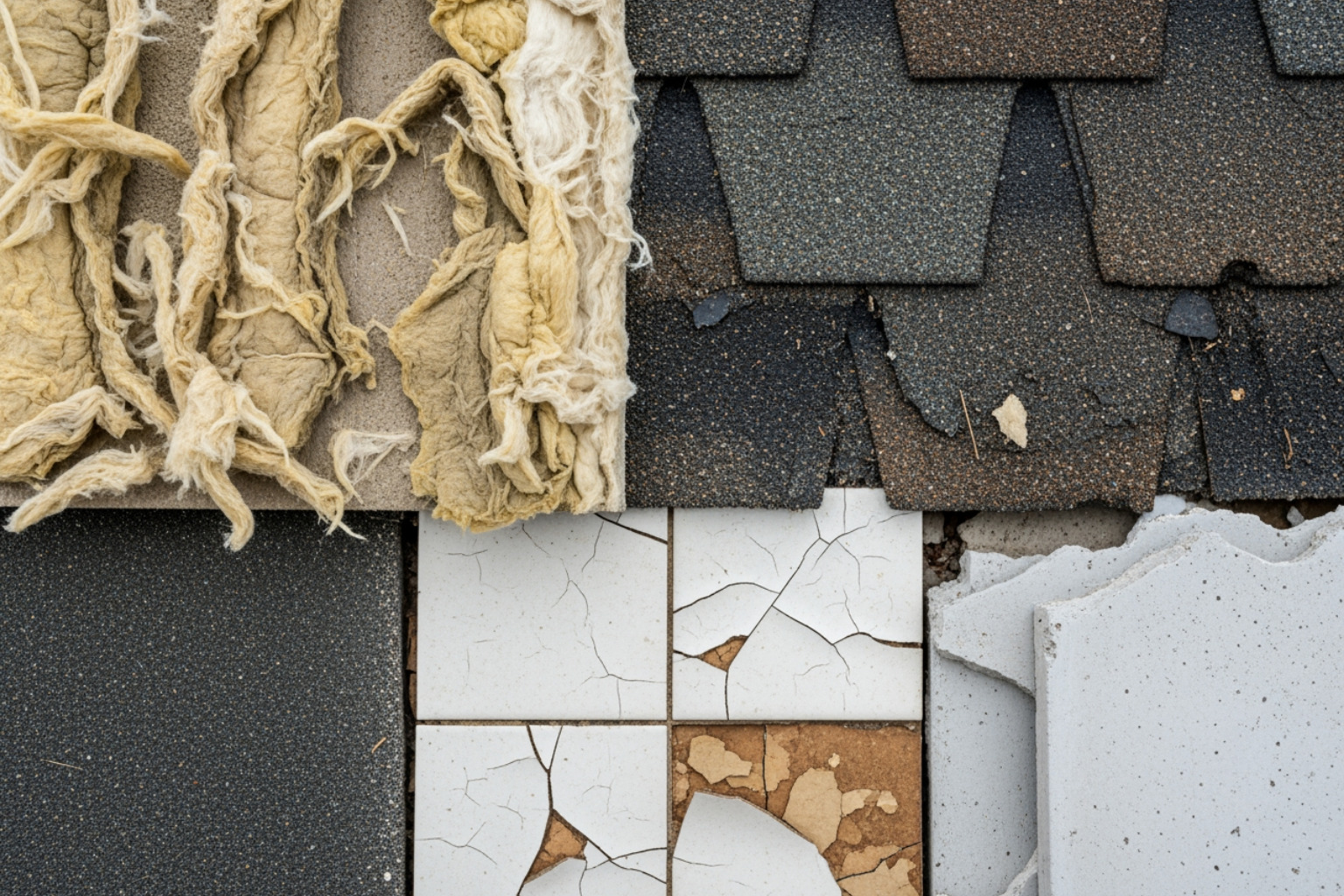
Asbestos is a group of naturally occurring mineral fibers that were once the “superstars” of the construction world. Because these fibers are incredibly strong, heat-resistant, and chemically stable, they were woven into more than 3,000 different building products. You can find them in everything from pipe insulation and vinyl floor tiles to roofing shingles and cement siding.
The problem arises when these materials are disturbed. When asbestos is “friable”—meaning it can be crumbled or reduced to powder by hand pressure—it releases microscopic fibers into the air. Once inhaled, these fibers lodge deep in the lung tissue. They don’t dissolve, and the body can’t get rid of them. Over decades, this can lead to devastating diseases like asbestosis (scarring of the lungs), lung cancer, and mesothelioma, a rare and aggressive cancer of the chest or abdominal lining.
Because of these extreme health risks, the law draws a very specific line in the sand: Asbestos-containing material (ACM) is defined as any material containing more than 1% asbestos. If a material hits that 1% mark, a strict set of asbestos abatement laws kicks in to ensure that any disturbance is handled with surgical precision. This is why more info about asbestos surveys is so critical; you cannot tell if a material contains asbestos just by looking at it.
Federal Asbestos abatement laws and EPA Regulations
At the federal level, the Environmental Protection Agency (EPA) is the primary watchdog for asbestos in the environment. Their authority comes largely from the Clean Air Act and the Toxic Substances Control Act (TSCA).
The heavy hitter here is the National Emission Standards for Hazardous Air Pollutants (NESHAP). These NESHAP work practices specify exactly how asbestos must be handled during the demolition or renovation of almost all structures. Whether it’s an office building, a shopping mall, or a large apartment complex, NESHAP requires:
- Notification: You must notify the state or local agency at least 10 working days before starting any demolition or renovation project.
- Emission Controls: You must prevent visible emissions to the outside air. This usually means “adequately wetting” the material so fibers can’t fly away.
- Waste Handling: Asbestos waste must be sealed in leak-tight containers while wet and labeled appropriately for transport to a permitted landfill.
The 2024 Chrysotile Ban and Modern Asbestos abatement laws
A major shift occurred recently. In March 2024, the EPA finalized a rule under TSCA Section 6(a) to ban chrysotile asbestos—the only type of asbestos still being imported or used in the U.S. This 2024 Chrysotile Ban is a landmark moment in asbestos abatement laws.
While more than 60 countries had already banned asbestos, the U.S. had struggled to pass a full ban since a 1989 attempt was largely overturned in court. The new ban targets the chlor-alkali industry, which uses asbestos diaphragms to produce chlorine. These facilities (there are currently 8 in the U.S.) have a 5-year transition period to move to asbestos-free technology. Other products, like asbestos cement sheets, are being phased out by 2026. For more context, check out more info about the asbestos ban. Even with this ban, “legacy” asbestos remains in millions of older buildings across New England, meaning abatement will remain a necessity for decades to come.
Notification and Work Practice Requirements for Demolition
If you are planning a demolition, the NESHAP compliance guide is your rulebook. There is a common misconception that residential homes are exempt. While NESHAP generally excludes “residential buildings having four or fewer dwelling units,” it does apply if those units are being demolished as part of a larger commercial or public project (like a highway expansion or a new shopping center).
The “10-day notice” is non-negotiable. Even if an inspection shows zero asbestos, you still have to notify the authorities of a demolition. During the work, we must ensure there are no “visible emissions.” This is achieved through wet methods, HEPA filtration, and sealing waste in 6-mil polyethylene bags or leak-tight drums.
OSHA Standards and Worker Protection Requirements
While the EPA protects the air we breathe, the Occupational Safety and Health Administration (OSHA) protects the people doing the work. OSHA’s asbestos abatement laws are focused on the “Permissible Exposure Limit” (PEL).
Employers must ensure that no worker is exposed to an airborne concentration of asbestos in excess of 0.1 fibers per cubic centimeter (0.1 f/cc) as an eight-hour time-weighted average (TWA). There is also an “Excursion Limit” (EL) of 1.0 f/cc over a 30-minute period. To stay below these limits, we use Personal Protective Equipment (PPE), including respirators and disposable coveralls, and conduct regular medical surveillance for our team.
Class I, II, III, and IV Asbestos Work under OSHA
OSHA categorizes asbestos work into four classes based on the risk level. Each class has different requirements for containment and “competent person” supervision.
- Class I: Removal of thermal system insulation (TSI) and surfacing asbestos-containing material. Typical requirements include negative pressure enclosures, HEPA vacuums, and full personal protective equipment.
- Class II: Removal of asbestos-containing material that is not TSI or surfacing, such as floor tile or roofing material. Typical requirements include wet methods and, in many cases, critical barriers.
- Class III: Repair and maintenance work where asbestos-containing material is likely to be disturbed. Typical requirements include glovebags and mini-enclosures.
- Class IV: Maintenance and custodial work where employees may contact asbestos-containing material but do not disturb it. Typical requirements include 2-hour awareness training and no-disturbance procedures.
For those working in maritime environments, the OSHA shipyard standards provide even more specific engineering controls for vessels, which often contain significant amounts of “presumed asbestos-containing material” (PACM) if built before 1980.
Asbestos Management in Schools and Public Buildings
The Asbestos Hazard Emergency Response Act (AHERA) is the primary law governing schools. Under these AHERA school regulations, local education agencies (LEAs) must:
- Perform an initial inspection to identify all ACM.
- Develop a comprehensive management plan.
- Perform reinspections every 3 years using accredited inspectors.
- Conduct visual surveillance every 6 months.
If the asbestos is in good condition, the law doesn’t always require removal. Instead, schools can use “response actions” like encapsulation (sealing the material) or enclosure (building a permanent airtight barrier around it).
Accreditation and Training for Asbestos Professionals
You can’t just hand a respirator to a general laborer and call it a day. The EPA’s Model Accreditation Plan (MAP) sets the MAP requirements for anyone working with asbestos in schools or public/commercial buildings.
Inspectors, management planners, project designers, and abatement workers must all complete accredited training. This ranges from a simple 2-hour awareness course for custodial staff to 40-hour initial training for supervisors, plus annual refreshers. The Asbestos School Hazard Abatement Reauthorization Act (ASHARA) eventually expanded these accreditation requirements from just schools to all public and commercial buildings.
Operations and Maintenance (O&M) Programs
When asbestos is present but not being removed, an Operations and Maintenance (O&M) program is required. The goal of an O&M program is to manage the asbestos “in place.” This involves:
- Training custodial and maintenance staff.
- Establishing special cleaning practices (using HEPA vacuums, never dry sweeping).
- Regular surveillance to ensure the material hasn’t become damaged or friable.
- Placing warning labels on ACM in routine maintenance areas (e.g., boiler rooms).
The EPA provides extensive O&M guidance to help building owners maintain a safe environment without the immediate cost of full abatement.
State-Specific Variations and Compliance Procedures
While federal laws provide the foundation, New England states often have much stricter “ceiling” rules. At Banner Environmental Services, we navigate these variations daily across Massachusetts, Rhode Island, New Hampshire, Vermont, Maine, and Connecticut.
- Massachusetts: Governed by the Department of Environmental Protection (MassDEP) and the Department of Labor Standards (DLS). They require specific licensing for every individual on-site and have very strict “clean air” clearance standards.
- Rhode Island: The Department of Health (RIDOH) oversees asbestos. Contractors must be licensed specifically in RI, and the state has its own unique notification forms and fees.
- New Hampshire: Recently updated their rules (Env-A 1800) in November 2024 to streamline notifications. They also have specific rules for “inactive asbestos disposal sites” in areas like Nashua and Hudson.
- Connecticut: Follows Public Health Code 19a-332a, which defines an “Asbestos Abatement Project” as anything involving more than 3 linear feet or 3 square feet of ACM.
For any project in these states, understanding the local more info about asbestos disposal rules is vital to avoid environmental liability.
Handling, Transporting, and Disposing of Asbestos Waste
The law doesn’t stop once the asbestos is out of the building. Waste disposal standards require a “cradle-to-grave” manifest system.
Asbestos waste must be double-bagged in 6-mil polyethylene bags or sealed in leak-tight containers. These containers must be labeled with the name of the waste generator and the location where the waste was produced. It can only be transported by a licensed hauler to a landfill permitted to accept asbestos. In New Hampshire, for example, there is a “Homeowner Notice of Asbestos Disposal” form for single-family owner-occupants, but for commercial projects, a formal Waste Shipment Record (WSR) must be submitted within 30 days of disposal.
Penalties for Violating Asbestos abatement laws
The penalties for cutting corners are severe. The EPA and state agencies have the power to issue civil penalties that can reach $25,000 per violation, per day. Under AHERA, schools can be fined up to $5,000 per day, per building.
Beyond the money, there is the risk of “injunctive relief”—where a court orders you to stop all work immediately—and even criminal prosecution for “knowing” violations of the Clean Air Act. If you’re curious about the risks of skipping steps, you can read more info about asbestos penalties. It is always cheaper and safer to do it right the first time.
Frequently Asked Questions about Asbestos Laws
Is asbestos fully banned in the United States?
Not entirely, but we are closer than ever. The 2024 EPA rule bans chrysotile asbestos, which was the last type being imported. However, some “legacy” uses are still permitted during a phase-out period (up to 12 years for some nuclear and military applications), and many products manufactured decades ago still sit on shelves or in buildings.
Who is required to be accredited for asbestos work?
Under the AHERA Model Accreditation Plan (MAP), any person who inspects for asbestos, designs abatement projects, writes management plans, or performs the actual removal work in schools or public/commercial buildings must be accredited. This includes workers, contractors, and supervisors.
What are the notification requirements for building demolition?
Under NESHAP, you must provide written notification to the appropriate state or local agency at least 10 working days before any demolition begins, regardless of whether asbestos is present. For renovations, notification is required if the amount of asbestos being disturbed exceeds 260 linear feet, 160 square feet, or 35 cubic feet.
Conclusion
Understanding asbestos abatement laws is about more than just checking boxes; it’s about protecting the health of your employees, students, and the general public. These regulations are complex and constantly evolving—as seen with the recent 2024 chrysotile ban and New Hampshire’s updated Env-A 1800 rules.
At Banner Environmental Services, we bring over 25 years of experience to every project. As a WBE and DCAMM-certified company, our licensed, professional team ensures full OSHA and EPA compliance across Massachusetts, Rhode Island, and the rest of New England. Whether you are in Boston, Providence, Nashua, or Springfield, we have the local expertise to handle your environmental challenges safely and legally.
Don’t leave your compliance to chance. Contact us for professional asbestos abatement and let our experts handle the regulations while you focus on your project.