
What Is a Building Asbestos Survey — and Do You Need One?
A building asbestos survey is a professional inspection that identifies whether asbestos-containing materials (ACMs) are present in a structure — and it is legally required before most renovation or demolition work, regardless of when the building was constructed.
Here’s what you need to know at a glance:
- What it is: A systematic inspection — including bulk sampling and lab analysis — to locate, identify, and assess ACMs in a building
- Who needs it: Owners and managers of commercial, industrial, institutional, or residential properties (with 5+ units) planning any renovation or demolition
- When it’s required: Before disturbing building materials in any structure, per EPA NESHAP (40 CFR 61.145)
- What’s at risk: Fines up to $25,000 per day, stop-work orders, criminal liability, and serious health consequences
- Key fact: There is no “safe” construction date — post-1980 and even post-1990 buildings can and do contain asbestos
Asbestos is a naturally occurring mineral fiber that was widely used in building materials from the 1930s through the 1970s — and beyond. When those materials are disturbed during a renovation or teardown, microscopic fibers become airborne. Breathing them in can cause lung cancer, mesothelioma, and asbestosis.
The critical problem? You cannot identify asbestos by looking at it. Only sampling and certified laboratory analysis can confirm whether a material contains asbestos. That’s exactly what a building asbestos survey is designed to do.
Despite a common belief in the construction industry, there has never been a complete ban on asbestos in the United States. The EPA restricted most uses in 1978, and a broader 1989 ban was largely overturned in court in 1991 — leaving many asbestos-containing products legal and still in use today.
I’m Stephen Wenzel, Co-Owner and Executive Vice President of Banner Environmental Services, with over 25 years of hands-on experience in asbestos inspections, pre-demolition surveys, and regulatory compliance across New England. In that time, I’ve seen how a proper building asbestos survey protects property owners, workers, and the public — and how skipping one can lead to consequences far more costly than the survey itself.
Understanding the Building Asbestos Survey
To understand why a building asbestos survey is so critical, we first have to look at the material itself. Asbestos isn’t a man-made chemical; it is a group of naturally occurring minerals. For decades, it was the “miracle material” of the construction world. It was cheap, incredibly durable, and offered unparalleled fire resistance and electrical insulation.

Because of these properties, asbestos was integrated into thousands of building products. According to more information from the EPA about asbestos, its use peaked between the 1930s and the 1970s, but it didn’t just disappear after that. In our work providing asbestos testing services across Massachusetts and Rhode Island, we still find it in buildings constructed as recently as the 2000s.
The danger arises when these materials become “friable.” This is a technical term we use to describe a material that can be crumbled or reduced to powder by hand pressure. When an ACM is friable, it can easily release microscopic fibers into the air. Once inhaled, these fibers lodge in the lungs forever.
Friable vs. Non-Friable Asbestos
| Characteristic | Friable Asbestos | Non-Friable Asbestos |
|---|---|---|
| Definition | Can be crumbled by hand pressure when dry. | Cannot be easily crumbled by hand. |
| Examples | Pipe insulation, sprayed-on fireproofing, acoustic ceiling texture. | Vinyl floor tiles, roofing shingles, cement siding. |
| Risk Level | High; fibers are easily released into the air. | Lower, unless sanded, sawed, or demolished. |
| Regulatory Handling | Requires strict “wet methods” and containment. | May be handled differently depending on condition. |
Types of Building Asbestos Surveys
Not every project requires the same level of investigation. Depending on your goals—whether you are buying a property, managing an existing one, or preparing for a total teardown—we perform different types of surveys.
- Management Survey: This is a standard survey used for ongoing building occupation. Its goal is to locate ACMs that might be damaged or disturbed during normal daily activities or routine maintenance. It helps us create an “Asbestos Register” for the building.
- Refurbishment Survey: Also known as a “Path of Construction” survey, this is targeted. If you are only renovating the third-floor bathrooms, we focus the inspection on the materials that will actually be disturbed in that specific area.
- Demolition Survey: This is the most intrusive type of building asbestos survey. Because the entire building is coming down, we must use “destructive sampling” techniques. This means breaking into wall cavities, lifting floorboards, and checking behind structural columns to find every hidden piece of asbestos before the wrecking ball swings.
For more details on which one fits your project, you can read our guide on what is an asbestos survey? to see how these different levels of inspection protect your specific investment.
Conducting a Building Asbestos Survey Safely
You should never attempt to “DIY” an asbestos inspection. Taking samples involves intentionally disturbing potentially hazardous materials. If done incorrectly, you could contaminate an entire building.
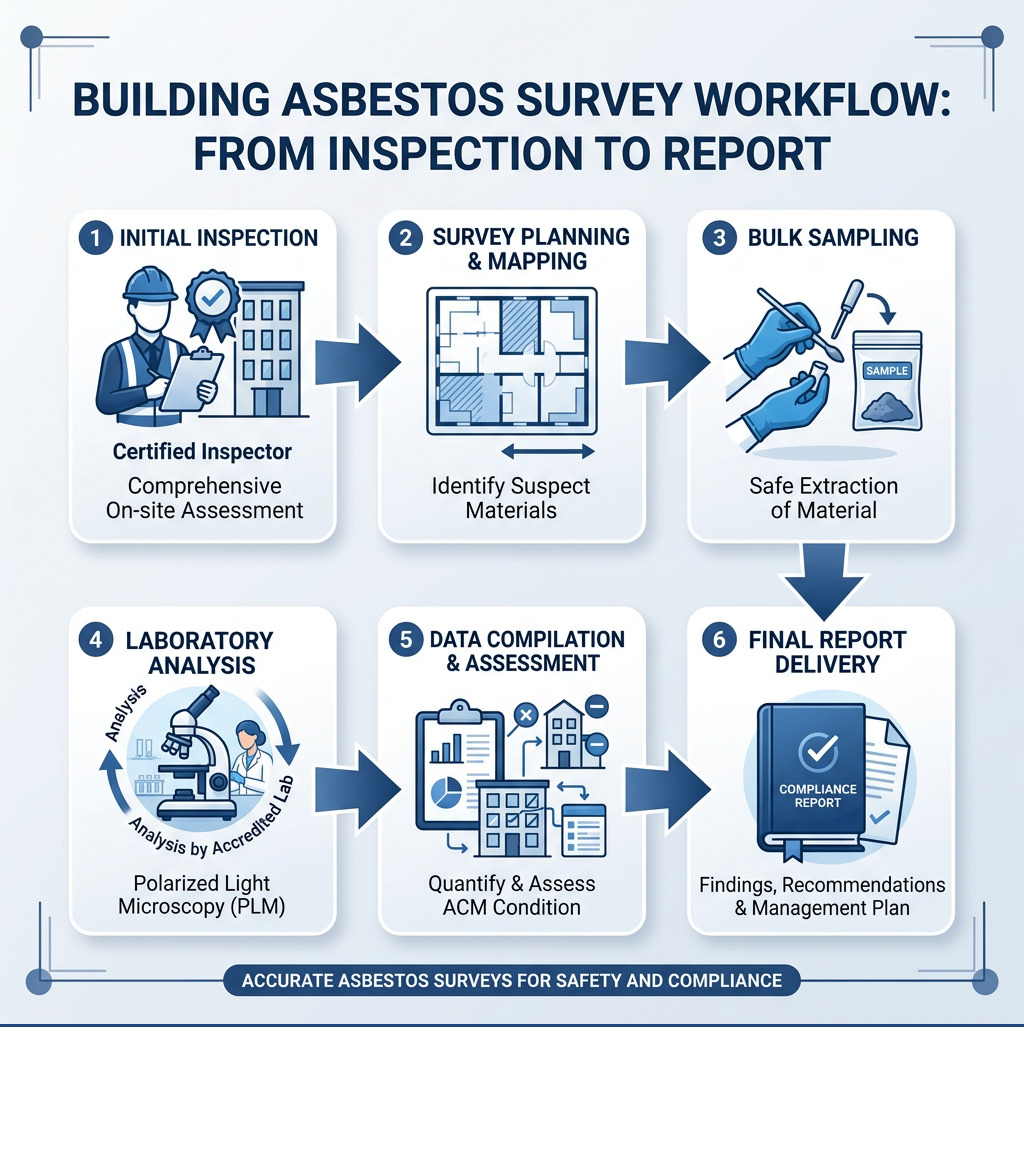
At Banner Environmental Services, our team follows a rigorous process:
- Certified Personnel: Surveys must be conducted by a Certified Asbestos Consultant (CAC) or an inspector with AHERA accreditation. In states like New Hampshire and Massachusetts, state-specific licensing is also mandatory.
- Physical Inspection: We walk through every accessible area (and inaccessible areas for demolition surveys) to identify “suspect” materials.
- Bulk Sampling: We take small physical pieces of the material. We use “shadow vacuuming” and wet methods to ensure no fibers escape during the sampling process.
- Laboratory Analysis: Samples are sent to NVLAP-accredited laboratories. They use Polarized Light Microscopy (PLM) to identify the exact percentage and type of asbestos present. To be legally classified as an ACM, the material must contain more than 1% asbestos.
- Chain of Custody: Every sample is tracked from the moment it’s cut until the lab issues the final report. This ensures the legal integrity of your asbestos abatement and survey documentation.
Why Every Property Needs an Inspection Regardless of Age
One of the biggest myths we encounter in the New England construction industry is the “1980 Rule.” Many contractors and property owners believe that if a building was built after 1980, it is “asbestos-free.”
This is a dangerous misconception.
While the EPA did ban many products in the late 70s, many others remained on the market. Furthermore, a 1991 court ruling overturned much of the EPA’s 1989 “Ban and Phase-Out Rule.” This means that products like roof coatings, vinyl floor tiles, and even some types of insulation continued to be manufactured with asbestos.
Consider this real-world case: A school built in 2009—decades after the supposed “ban”—underwent a roof replacement. Because the facility manager followed the law and ordered a building asbestos survey, they discovered asbestos in the roof tar. Because they found it before work started, they were able to hire a qualified team to remove it safely. If they had skipped the survey, they would have contaminated the entire school grounds.
Why does this happen?
- Imported Materials: Many building materials imported from countries with fewer regulations still contain trace amounts of asbestos.
- Stockpiled Inventory: Builders often used materials they already had in stock, even after certain bans took effect.
- Manufacturer Documentation: You cannot always rely on a “safety data sheet” from 20 years ago. Only a physical test provides the certainty required by law.
This is why we emphasize five reasons for asbestos testing: it’s about more than just age; it’s about the reality of modern supply chains.
Regulatory Compliance and Legal Consequences
The legal framework surrounding asbestos is not a suggestion—it is a federal mandate. The primary regulation is the EPA NESHAP (National Emission Standards for Hazardous Air Pollutants), specifically 40 CFR 61.145.
Under NESHAP, the “owner or operator” of a renovation or demolition activity must conduct a thorough inspection for the presence of asbestos prior to the start of work. This applies to all “facilities,” which includes almost everything except a single-family home or a residential building with four or fewer units (though local state laws in places like Massachusetts often have even stricter residential requirements).
The High Cost of Cutting Corners
If you decide to skip a building asbestos survey, you aren’t just risking your health—you are risking your business and your freedom.
- Civil Fines: The EPA can levy fines of up to $25,000 per day for non-compliance.
- Stop-Work Orders: If a state inspector (like those from the MA Department of Environmental Protection) visits your site and you don’t have a survey report on hand, they will shut down your project immediately. This can lead to massive delays and “liquidated damages” on a construction contract.
- Criminal Prosecution: In extreme cases, property owners and contractors have been sentenced to prison. For example, a principal of a capital management firm received an 8-month prison sentence and a $100,000 fine for failing to obtain a pre-work survey before an apartment renovation.
- Liability Lawsuits: If workers or tenants are exposed because you didn’t do your due diligence, the resulting lawsuits can easily reach into the millions of dollars.
Interpreting the Survey Report and Taking Action
Once the survey is complete, you will receive a comprehensive report. This document is your roadmap for the rest of your project. A professional report, following the standard practice for comprehensive building asbestos surveys, should include:
- An Executive Summary: A quick look at what was found and what needs immediate attention.
- The ACM Results Table: This is the most important part. It lists every material tested, its location, the percentage of asbestos, and its condition (e.g., “Good,” “Damaged,” or “Significantly Damaged”).
- Quantity Assessment: How many linear feet of pipe wrap or square feet of floor tile are present? This is essential for getting accurate bids for removal.
- Recommendations: Should the material be removed immediately, or can it be managed in place through an Operations and Maintenance (O&M) Plan?
What Happens After the Report?
If the building asbestos survey comes back “clean” (no asbestos found), you are free to proceed with your project as planned. Just keep that report in your files—you’ll need it to get your building permits.
If asbestos is found, you have a few options:
- Abatement: Hiring a licensed team like us to remove the material before the renovation begins.
- Encapsulation/Enclosure: Sealing the asbestos so it cannot release fibers. This is often an option if the material is in good condition and won’t be disturbed by your project.
- Management in Place: If you aren’t renovating that specific area, you can leave the asbestos where it is, provided you have a plan to monitor its condition over time.
Frequently Asked Questions
Are buildings built after 1980 exempt from a building asbestos survey?
Absolutely not. There is no “cutoff date” in federal law that exempts a building from an asbestos survey. The EPA NESHAP regulation requires a “thorough inspection” regardless of the age of the facility. As we’ve seen with modern roofing materials and joint compounds, asbestos is still a very real risk in newer structures.
What happens if I skip a survey before renovation?
Beyond the massive fines and potential jail time mentioned earlier, you face a “contamination event.” If a contractor unknowingly rips out asbestos-containing drywall or pipe insulation, they spread dust through the entire HVAC system. What could have been a $2,000 localized removal project suddenly becomes a $50,000 whole-building decontamination project.
How much does a typical survey cost and how long does it take?
The cost of a building asbestos survey depends on the size of the building (square footage) and the number of samples required. A small retail storefront will cost significantly less than a 100,000-square-foot warehouse. Generally, the on-site inspection takes a few hours to a day, and lab results typically take 3 to 5 business days, though “rush” turnaround is usually available for urgent projects.
Conclusion
A building asbestos survey is the foundation of a safe, legal, and successful construction project. It’s the only way to truly know “what lies beneath” the surface of your walls, floors, and ceilings. By identifying these hazards early, you protect your workers from life-threatening diseases and protect yourself from devastating legal and financial penalties.
At Banner Environmental Services, we bring over 25 years of experience to every inspection. Whether you are in Boston, Providence, Nashua, or anywhere else in New England, our licensed professionals ensure your project stays in full compliance with OSHA and EPA regulations.
Don’t leave your project to chance. If you’re planning a renovation or demolition, contact us today for professional asbestos abatement and survey services. We’ll help you breathe easy knowing your property is safe.