
Understanding Popcorn Ceiling Asbestos Risks and History
Popcorn ceiling asbestos is a serious health hazard found in millions of older homes across the United States — and many property owners don’t know they’re living with it.
Quick facts about popcorn ceiling asbestos:
| Question | Answer |
|---|---|
| Which homes are at risk? | Homes built or renovated between 1945 and the early 1990s |
| How much asbestos can they contain? | Between 1% and 10% by composition |
| How common is it? | 45%–70% of homes built before 1985 may be affected |
| Is it dangerous right now? | Only if the ceiling is damaged, crumbling, or disturbed |
| What should you do? | Have it professionally tested before any renovation or repair |
Popcorn ceilings — also called acoustic ceilings, cottage-cheese ceilings, or stipple ceilings — were a go-to finish from the 1950s through the 1980s. They were cheap, fast to apply, and good at hiding imperfections. But manufacturers routinely mixed asbestos into the spray texture for added fire resistance and durability.
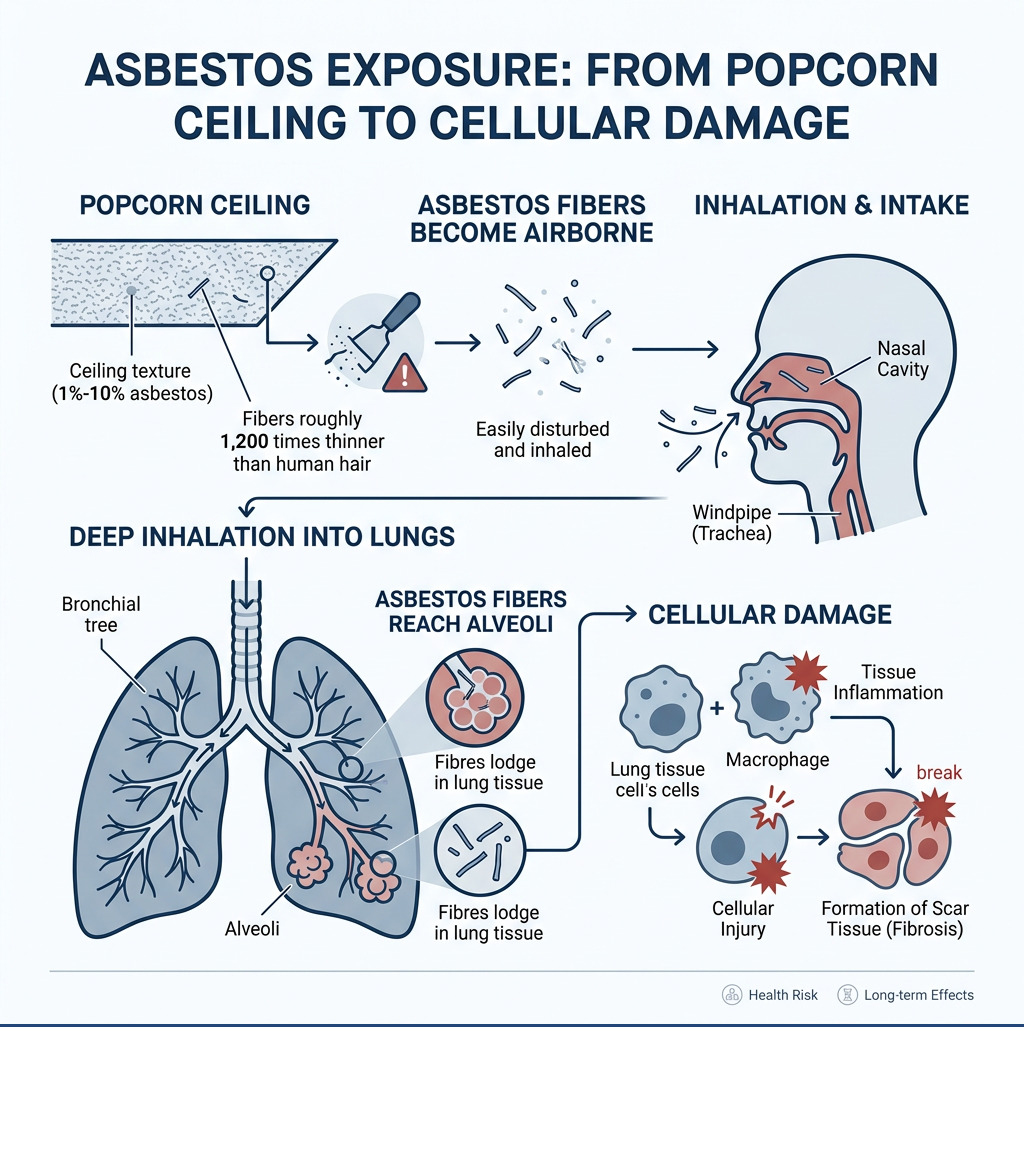
The problem? Asbestos fibers are microscopic. They are roughly 1,200 times thinner than a human hair. You can’t see them, smell them, or detect them without lab testing. And once disturbed — through scraping, water damage, drilling, or renovation — those fibers become airborne and can be inhaled deep into the lungs.
In one documented case, a woman who lived for 30 years beneath a crumbling, water-damaged asbestos ceiling was later diagnosed with lung cancer and asbestosis — a stark reminder that long-term, low-level exposure carries real consequences.
I’m Stephen Wenzel, Co-Owner and Executive Vice President of Banner Environmental Services, with over 25 years of hands-on experience in asbestos abatement, pre-demolition surveys, and hazardous material remediation across New England. Throughout my career, I’ve worked directly on hundreds of projects involving popcorn ceiling asbestos — helping residential and commercial property owners test, manage, and safely eliminate this hidden threat. In this guide, I’ll walk you through everything you need to know to protect your property and the people in it.
When we walk into a home built in the mid-20th century, that “cottage cheese” texture on the ceiling is often the first thing we notice. While it might just look like an outdated design choice today, it was once the gold standard of modern construction. Unfortunately, that history is inextricably linked with asbestos.
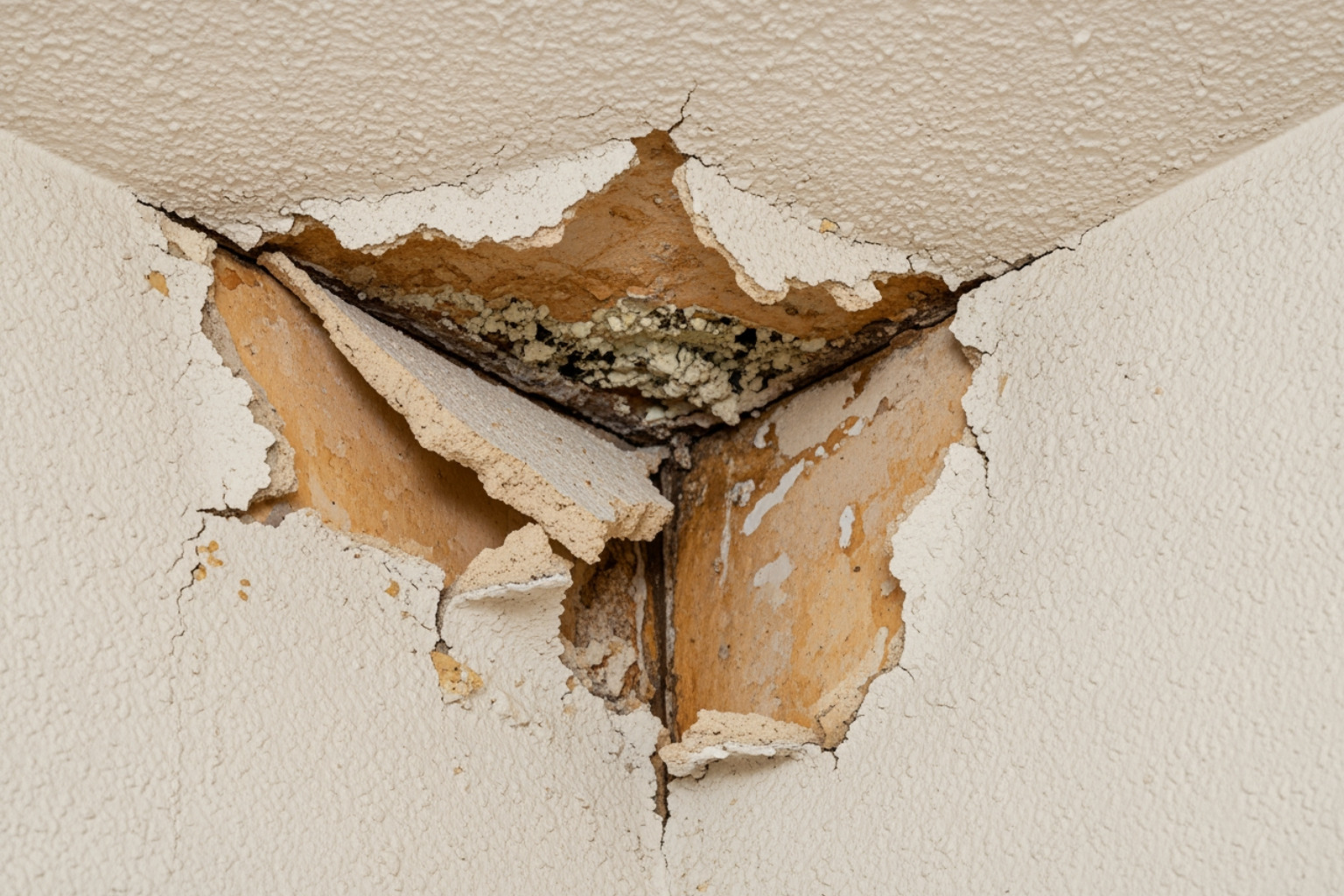
From 1945 until the early 1990s, popcorn ceiling asbestos was incredibly common. Statistics suggest that over 50% of existing homes likely contain asbestos in at least one building material. If your home was built or remodeled before 1985, there is a 45% to 70% chance that your textured ceilings contain this hazardous mineral. Because the risks aren’t always visible to the naked eye, we always recommend starting with a professional asbestos survey to identify exactly what you’re dealing with before swinging a hammer.
Why Asbestos Was the Standard for Decades
It’s easy to look back and wonder why anyone would put a known carcinogen in their home. However, at the time, asbestos was viewed as a “miracle mineral.” It provided incredible tensile strength to brittle paint mixtures and offered unparalleled thermal insulation.
Beyond its physical strength, it was prized for its fire resistance and sound absorption qualities—making it perfect for multi-family units or noisy basements. It was also a dream for builders because it was cost-effective and did a fantastic job of concealing imperfections in drywall taping or plaster work. Because of these benefits, strict regulations were only imposed in the 1970s, long after millions of tons had already been installed in American living rooms.
When Was Popcorn Ceiling Asbestos Banned?
The timeline of asbestos regulation is often confusing for homeowners. In 1973, the EPA officially banned asbestos in spray-on ceiling materials under the National Emission Standards for Hazardous Air Pollutants (NESHAP). This was followed by a 1978 regulation from the Consumer Product Safety Commission (CPSC) that specifically targeted asbestos in consumer patching compounds and textured paints.
However, there was a major loophole: manufacturers were allowed to use up their existing inventory. This meant that even though the material was eventually banned, it continued to be installed in homes well into the 1980s and, in some cases, the early 1990s. If your home was built before 1990, you should never assume it is asbestos-free without a lab test.
Health Hazards: Why Friable Asbestos is a “Sleeping Monster”
In the industry, we often refer to undisturbed asbestos as a “sleeping monster.” As long as it stays put and remains in good condition, it isn’t necessarily a threat. The danger lies in its “friability.”
A material is considered friable if it can be crumbled or reduced to powder by hand pressure. Popcorn ceilings are highly friable. When you scrape them, or even when they begin to flake due to age or water damage, they release microscopic dust into the air. Once inhaled, these fibers can cause:
- Asbestosis: A chronic lung disease caused by scarring of lung tissue, leading to severe shortness of breath.
- Mesothelioma: A rare and aggressive cancer of the lining of the lungs or abdomen, almost exclusively linked to asbestos exposure.
- Lung Cancer: Increased risk, especially for smokers.
In one case study, researchers followed a woman who lived with an asbestos-containing ceiling for 30 years. Persistent water damage caused the ceiling to slowly crumble over decades. By the time she was diagnosed with lung cancer in 2010, the damage was irreversible. This highlights the “latency period” of asbestos diseases, which can take 10 to 50 years to appear.
High-Risk Groups and Secondary Exposure
While everyone in a home with a deteriorating ceiling is at risk, certain groups face higher stakes. Children are particularly vulnerable because they have more years ahead of them for diseases with long latency periods to develop. The elderly and those with pre-existing respiratory issues are also at higher risk for immediate complications.
We also have to consider secondary exposure. Construction workers or DIY renovators who don’t use proper PPE can carry these invisible fibers home on their clothes, skin, and hair, unknowingly exposing their families. This is similar to the risks found with asbestos insulation, where fibers can easily migrate through a home’s ventilation system.
How to Safely Test for Popcorn Ceiling Asbestos
You cannot tell if a ceiling has asbestos just by looking at it. Even if your neighbor’s house was built at the same time and tested negative, yours could be different. The only way to know for sure is through bulk sampling and analysis at an NVLAP-accredited laboratory.
If you decide to take a sample yourself (which we generally discourage due to the risk of fiber release), you must follow strict safety protocols:
- Wear PPE: Use a N95 or P100 respirator and gloves.
- Wet Sampling: Lightly mist the area with water mixed with a little detergent. This prevents dust from flying when you scrape.
- Collect Multiple Samples: Take small amounts (about a teaspoon) from at least three different areas of the ceiling, as the asbestos may not be mixed evenly throughout the texture.
- Seal and Clean: Place samples in heavy-duty zip-lock bags and wipe down the area with a wet cloth.
For the most accurate and safest results, it is always best to hire a professional for asbestos testing. We have the tools to sample without contaminating your living space.
Professional Remediation: Encasement, Encapsulation, and Removal
Once you’ve confirmed the presence of popcorn ceiling asbestos, you have three main paths forward. Each has its pros and cons depending on your budget and long-term plans for the home.
| Method | Description | Pros | Cons |
|---|---|---|---|
| Encasement | Covering the ceiling with a new layer of drywall or ceiling panels. | No dust created; very safe. | Adds weight; must be disclosed during a sale. |
| Encapsulation | Spraying the ceiling with a special high-solids sealant (penetrating or bridging). | Binds fibers together; prevents flaking. | Makes future removal much harder and more expensive. |
| Removal | Complete physical scraping and disposal of the material. | Permanently eliminates the hazard. | Most expensive; requires full professional containment. |
Professional removal is the most intensive process. We utilize negative air pressure machines equipped with HEPA filtration to ensure that no dust escapes the work area. We use “wet scraping” techniques, where the material is saturated with water to keep fibers heavy and grounded, and all waste is double-bagged and disposed of at licensed hazardous waste facilities. You can learn more about our specific removal process here.
The Vermiculite Connection in Older Homes
In many New England homes, if you have an asbestos popcorn ceiling, there’s a chance you might also have vermiculite insulation in your attic. Much of the vermiculite used in the 20th century came from a mine in Libby, Montana, which was contaminated with a particularly toxic form of asbestos called amphibole.
These hazards often overlap during renovations. If you are pulling down a ceiling to remove the “popcorn” texture, you might inadvertently disturb the insulation sitting right above it. It’s vital to have a comprehensive inspection of all potential “asbestos headaches” before starting any work.
Legal Requirements and Selling Your Home
If you’re planning to sell a home in Massachusetts, Rhode Island, or anywhere in New England, asbestos is a major factor in the transaction. By law, you must disclose any known asbestos-containing materials (ACM) to potential buyers.
Failure to follow NESHAP or state-specific mandates during a renovation can lead to massive fines and legal liability. Most buyers will insist on an air clearance test after any abatement work to prove the home is safe for occupancy. Professional asbestos abatement ensures that all paperwork and safety standards are met, protecting your real estate investment.
The Dangers of DIY Popcorn Ceiling Asbestos Removal
We’ve seen many well-intentioned homeowners try to tackle this as a weekend project. It often ends in a nightmare.
A standard dust mask from the hardware store will NOT protect you from asbestos fibers. These fibers are so small they pass right through common filters. Without professional-grade containment, you risk “cross-contamination”—spreading toxic dust into your carpets, furniture, and HVAC system, where it can remain for years. Furthermore, disposing of asbestos in your regular trash is illegal and carries heavy penalties.
Why Painting Over Texture Isn’t Always Safe
Many people ask if they can just “paint over it.” While painting is a form of encapsulation, it comes with risks.
- Weight: Popcorn texture is heavy. Adding layers of wet paint can make the texture pull away from the drywall, causing the whole ceiling to collapse.
- Future Disturbance: If you ever need to install a new light fixture or repair a leak, you’ll be cutting into that “sealed” asbestos, releasing fibers anyway.
- Specific Sealants: You can’t just use regular latex paint. You need “bridging encapsulants” that create a thick membrane or “penetrating sealants” that soak in and bind the fibers to the substrate.
Step-by-Step Professional Abatement Procedures
When we handle a project at Banner Environmental Services, we follow a rigorous, OSHA-compliant process:
- Site Containment: We seal off the work area with 6-mil poly plastic sheeting.
- Furniture Removal/Covering: Anything that can’t be moved is double-wrapped in plastic.
- Critical Barriers: We seal all vents, windows, and doors to prevent air migration.
- Wetting Agents: We use specialized amended water (water mixed with a surfactant) to thoroughly saturate the ceiling.
- Double-Bagging: All waste is placed into labeled, leak-tight 6-mil bags while still wet.
- Final HEPA Vacuuming: Once the texture is gone, we use HEPA vacuums and wet-wiping to ensure the substrate is perfectly clean.
Frequently Asked Questions about Asbestos Ceilings
How much does it cost to remove asbestos popcorn ceilings?
While we don’t provide flat pricing because every home is different, the cost is influenced by the square footage, the height of the ceilings, and the complexity of the containment. For example, a “popcorn” ceiling that has been painted over multiple times is much harder to remove than unpainted texture, as the water can’t penetrate the paint. Disposal permits and regional landfill fees in New England also play a role in the final investment.
Can I just cover my popcorn ceiling with drywall?
Yes, this is known as encasement. It’s often a great strategy for homeowners who want a flat ceiling without the mess of scraping. However, you must remember that the asbestos is still there. You are required to disclose this when you sell the home, and any future renovations (like adding recessed lighting) will require professional asbestos handling.
How long do asbestos fibers stay in the air after disturbance?
If disturbed, asbestos fibers are so light they can stay airborne for 48 to 72 hours in a room with still air. If there is a breeze or an HVAC system running, they can stay suspended indefinitely or be “re-entrained” (kicked back up) every time someone walks across the carpet. This is why professional air exchange and clearance testing are non-negotiable.
Conclusion
Dealing with popcorn ceiling asbestos can feel like an overwhelming “headache,” but it doesn’t have to be a danger to your family. With the right information and a professional team, you can manage these risks effectively.
At Banner Environmental Services, we bring over 25 years of specialized experience to every job. As a WBE and DCAMM-certified company, we pride ourselves on maintaining the highest standards of safety and compliance across Massachusetts and Rhode Island. Whether you’re in Boston, Providence, or expanding into our new service areas in New Hampshire, Connecticut, Vermont, or Maine, we are here to help.
Don’t leave your health to chance. If you suspect your home has hazardous materials, contact us for professional vermiculite and asbestos removal today. We’ll help you turn that “sleeping monster” into a distant memory.