
Mold in Your Home? Here’s How to Find Help Fast
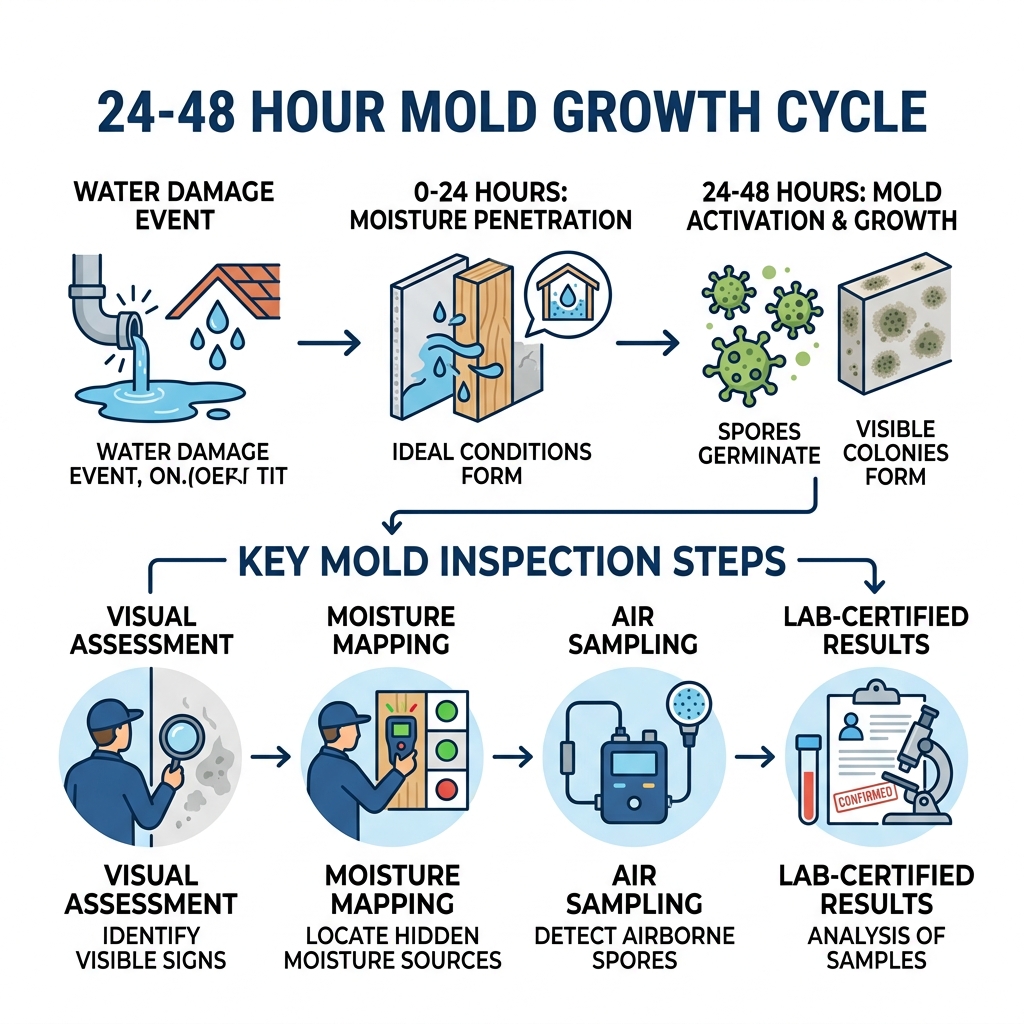
Mold inspection near me is one of the most urgent searches a property owner can make — and for good reason. Mold can begin growing within just 24 to 48 hours after water damage, often spreading silently behind walls, under floors, and inside HVAC systems long before you see or smell anything unusual.
Here’s what you need to know right away:
- Signs you need an inspection: musty odors, visible dark spots, recent water damage, or unexplained respiratory symptoms
- What a mold inspection includes: visual assessment, moisture mapping, air sampling, and lab-certified results
- Who to call: a licensed, independent mold inspector who does not also sell remediation services
- How fast results come back: typically within 2 to 5 business days, with rush options available
- Next steps after inspection: if mold is confirmed, a certified remediation company follows a strict protocol to contain and remove it safely
If any of those warning signs sound familiar, keep reading. This guide walks you through everything you need to know — from finding a qualified inspector to understanding your lab report and what comes next.
I’m Stephen Wenzel, Co-Owner and Executive Vice President of Banner Environmental Services, with over 25 years of experience in environmental remediation, mold remediation protocols, and hazardous material compliance across Massachusetts, Rhode Island, and Greater New England — including thousands of mold inspection near me situations just like yours. My goal here is to give you clear, honest guidance so you can act quickly and confidently.
Easy mold inspection near me word list:
Signs You Need a Professional Mold Inspection Near Me

If you find yourself searching for a mold inspection near me, chances are your “gut feeling” is already picking up on something. Mold doesn’t always announce itself with a giant green patch on the wall. Often, it’s a stealthy squatter.
One of the most common indicators is a persistent, musty odor. This smell is actually caused by volatile organic compounds (VOCs) released by mold as it grows and metabolizes organic matter like your drywall or floor joists. If a room smells like “old basement” or rotting vegetation even after a deep clean, it’s time to call in the pros.
Physical health is another major red flag. If you or your family members experience “indoor respiratory issues” that seem to vanish when you go to work or run errands, the air quality in your home is likely compromised. Common symptoms include sneezing, runny nose, itchy eyes, and skin rashes. According to the Scientific research on mold health effects, these allergic reactions can be quite severe for sensitive individuals.
You should also check out the EPA’s Article: Ten Things You Should Know About Mold to understand how moisture and mold are inextricably linked. If you’ve had a pipe burst in Worcester, MA, or a leaky roof in Providence, RI, you have a high risk of hidden growth. Even if you dried the area, moisture trapped behind baseboards or inside wall cavities can foster a colony.
For more detailed information, read our guide on mold dangers.
Common Causes and Prevention Strategies
In our 25+ years of experience across New England, we’ve seen it all. Mold is an opportunist. It only needs three things: spores (which are everywhere), a food source (wood, paper, carpet), and moisture.
Common culprits include:
- Roof Leaks: Water trickling into the attic can saturate insulation and ceiling drywall.
- Poor Ventilation: Bathrooms without proper exhaust fans or kitchens with heavy steam are prime real estate for mold.
- Crawl Space Moisture: Many homes in places like Framingham or Warwick have damp crawl spaces that allow moisture to rise into the living areas.
- Pipe Bursts and Slow Leaks: A tiny pinhole leak behind a vanity can create a massive mold problem before it’s ever detected.
Prevention is about moisture control. We recommend keeping indoor humidity between 30% and 50%. Using dehumidifiers in basements is a must for New England homeowners. For more tips, see our specific advice on basement mold.
Health Risks Associated with Exposure
We take mold seriously because it isn’t just a property issue; it’s a health issue. Mold exposure can trigger asthma attacks in sensitive individuals and lead to chronic sinus infections. Infants and the elderly are particularly vulnerable.
In some cases, mold produces mycotoxins, which are toxic substances that can lead to more serious neurological or immune system impacts. While not all mold is “toxic black mold,” any elevated mold level indoors is a concern for long-term health. If you are feeling sick indoors, don’t wait for the problem to resolve itself—it won’t.
Understanding the Mold Inspection and Testing Process
When you hire a professional for a mold inspection near me, they shouldn’t just walk around and point at things. A thorough inspection is a scientific process. At Banner Environmental Services, we use a combination of high-tech tools and old-fashioned “boots on the ground” investigation to find the root cause.
The process typically involves:
- Visual Assessment: The inspector looks for staining, “fuzzy” textures, and signs of water intrusion.
- Moisture Mapping: Using moisture meters and infrared cameras (thermal imaging), we can see “cold spots” behind walls that indicate moisture, even if the surface feels dry.
- Air Sampling: This is crucial. We collect air samples inside the home and compare them to a “baseline” outdoor sample. If the indoor spore count is significantly higher or contains species not found outside, you have an active indoor growth problem.
- Surface Swabs or Tape Lifts: If we see visible growth, we take a physical sample to identify the specific species of mold.
To learn more about how we handle these technical steps, visit our page on inspection and testing.
Essential Inspection Tools:
- Infrared Cameras: Detects temperature differences caused by moisture.
- Hygrometers: Measures humidity levels in the air.
- Borescopes: Tiny cameras that can look inside wall cavities through a small hole.
- Air Pumps: Calibrated machines that pull a specific volume of air through a collection cassette.
Preparing for Your Mold Inspection Near Me
To get the most accurate results from your mold inspection near me, you need to prepare your home. Think of it like a doctor’s visit for your house.
- Keep Windows and Doors Closed: For at least 24 hours before air testing, keep all exterior openings shut. This ensures the air sample reflects the actual “stagnant” environment of the home.
- HVAC Settings: Keep your air conditioner or heater running normally, but avoid using “fan only” modes that might artificially stir up dust right before the test.
- Clear Access: Ensure the inspector can get into the attic, the crawl space, and the back of closets.
- Pet Relocation: It’s usually best to keep pets in a separate room or out of the house so they don’t interfere with the equipment.
- Documentation: Have a list of any recent leaks, floods, or areas where you’ve noticed a smell.
For those moving toward the next phase, you can find more about mold remediation here.
Interpreting Your Lab Results and Reports
Once the samples are collected, they are sent to an independent, accredited laboratory. Usually, you’ll receive a digital report within 48 hours to 5 days.
The report will include:
- Spore Counts: The number of spores per cubic meter of air.
- Species Identification: Names like Aspergillus/Penicillium or Stachybotrys (the infamous black mold).
- Comparison Data: How your indoor air stacks up against the outdoor air.
- Remediation Protocol: If mold is found, a professional report should provide a “roadmap” for how to fix it.
Understanding these results is key to choosing the right professional removal strategy.
Choosing the Right Mold Inspector: Certifications and Independence
Not all inspectors are created equal. When searching for a mold inspection near me, look for credentials. In the industry, the gold standard is IICRC Certification (Institute of Inspection, Cleaning and Restoration Certification).
In states like Massachusetts and Rhode Island, while specific “mold licenses” vary, having a team that is DCAMM certified and OSHA compliant is non-negotiable. We pride ourselves on our 25+ years of experience and our licensed remediation expertise.
Why Independence Matters in Testing
This is one of the most important pieces of advice I can give you: Beware of the “Free Inspection” from a company that only does remediation.
There is a significant conflict of interest when the person telling you that you have a $5,000 mold problem is the same person who gets paid $5,000 to fix it. Independent testing ensures:
- Unbiased Reporting: The data is the data. There’s no incentive to “find” mold that isn’t there.
- Consumer Protection: You get a third-party verification of the problem, which is often required by insurance companies.
- Clear Protocols: An independent inspector writes the “prescription,” and the remediation company (like us) follows it to the letter.
We often work with third-party testers to ensure our clients in Boston or Providence get the most objective results possible. This is especially vital when dealing with commercial mold issues.
Costs, Insurance, and What Happens After Your Mold Inspection Near Me
“How much is this going to cost?” It’s the first question everyone asks. While we don’t provide flat pricing here (because every home in New England is different!), we can tell you what factors influence the price.
Factors Affecting Cost:
- Square Footage: A 5,000 sq. ft. commercial building in Hartford, CT, costs more to inspect than a 900 sq. ft. condo in Brookline, MA.
- Number of Samples: More air and surface samples mean higher lab fees.
- Accessibility: If an inspector has to crawl through a tight, damp space in a Cape Cod basement, it might affect the labor cost.
- Urgency: Rush lab results (24-hour turnaround) usually come with a premium.
When it comes to insurance, coverage for mold varies wildly. Most policies cover mold only if it resulted from a “covered peril,” like a sudden pipe burst. If the mold is from years of poor maintenance or high humidity, insurance likely won’t pay. Always document everything and provide your adjuster with the professional lab report. For business owners, we have specialized info on commercial remediation.
When is Remediation Necessary?
You need professional remediation when:
- The Spore Count is Elevated: If indoor levels are significantly higher than outdoor levels.
- Visible Growth Exceeds 10 Square Feet: The EPA suggests professional help for areas larger than a 3×3 patch.
- Toxic Species are Present: If Stachybotrys is found, it needs to be handled with extreme care.
- Health Symptoms Persist: Even if you can’t see the mold, if it’s making you sick, it has to go.
There is a big difference between just cleaning mold and truly remediating it. Learn more about remediation vs removal.
Post-Remediation Clearance Testing
Once we finish a job in Lowell, MA, or Warwick, RI, we don’t just pack up and leave. We recommend clearance testing. This is a final air test conducted after the cleaning is done but before the “containment” (the plastic barriers) is taken down. This proves the air is safe and the mold is gone.
It’s the final step in ensuring you don’t let the mold win.
Beyond Mold: Addressing Asbestos and Other Hidden Hazards
In New England, we have some of the most beautiful historic homes in the country—from the Victorians in Newton to the colonials in Salem. However, older homes often hide more than just mold.
When we are called for a mold inspection near me, we frequently discover other hazardous materials during the process. If we have to cut into a wall to find a leak, we have to be sure we aren’t disturbing asbestos.
- Asbestos Abatement: Common in floor tiles, pipe insulation, and older shingles. We provide full asbestos services across the region.
- Popcorn Ceiling Removal: Many ceilings installed before the 1980s contain asbestos. If these get wet from a leak, they become a dual mold and asbestos threat.
- Vermiculite Insulation: Often found in New England attics, this pebble-like insulation can contain asbestos fibers.
- Floor Tile Removal: Those old 9×9 tiles are almost always asbestos-containing.
Whether you’re in a retail store in Framingham or a home in Marlborough, we ensure all hazardous material disposal follows strict OSHA and EPA guidelines. Check our Marlborough services for more local info.
Frequently Asked Questions about Mold Inspections
How long does a mold inspection take?
For a standard single-family home, a thorough inspection usually takes between 1.5 to 3 hours. This allows time for a full walkthrough, moisture mapping, and the collection of air samples. Larger commercial properties will naturally take longer.
Can I use a DIY mold test kit instead?
We generally advise against them. DIY kits from big-box stores often just tell you “mold is present”—which we already know, because mold spores are everywhere. They don’t provide the “baseline” comparison or the professional moisture mapping needed to find the source of the problem. Without the source, the mold will just come back.
Does homeowners insurance cover mold testing?
As mentioned earlier, it depends on the cause. If you have a flood and the insurance company is paying for the cleanup, they will often cover the testing as part of the claim. If you just decided to test your basement because it smells funny, you will likely pay out of pocket.
Take Action for a Healthier Home Environment
Finding mold can be stressful, but you don’t have to navigate it alone. At Banner Environmental Services, we bring over 25 years of New England expertise to every job. Whether you are dealing with a damp basement in New Bedford, a commercial air quality issue in Boston, or a suspected asbestos problem in Providence, our team is ready to help.
We are a WBE-certified (Woman Business Enterprise) company with a reputation for honesty, transparency, and rigorous compliance. We don’t use “scare tactics”—we use science and hard work to make your environment safe again.
Don’t let a small moisture problem turn into a major health and structural crisis. If you suspect mold, asbestos, or water damage, reach out to a professional team you can trust.
Schedule your commercial mold remediation today or contact us for a residential consultation across Massachusetts and Rhode Island. We’re here to help you breathe easier.