
Why Asbestos Abatement in Boston Is a Problem You Can’t Ignore
Asbestos abatement Boston property owners need is specialized, regulated, and not something to put off. Here’s what you need to know right away:
Quick answers for Boston property owners:
- What it is: Asbestos abatement is the process of safely containing or removing asbestos-containing materials (ACMs) from a building before they become a health hazard.
- Who needs it: Any owner of a Boston property built before 1980 — residential, commercial, or industrial — should have it inspected before renovating, selling, or demolishing.
- Why it matters: Disturbed asbestos fibers cause serious diseases including mesothelioma, lung cancer, and asbestosis. Symptoms can take up to 40 years to appear.
- What’s required: Massachusetts law requires licensed contractors, proper permits, and post-removal air clearance testing for all abatement work.
- What to do first: Contact a licensed asbestos inspector before starting any renovation or demolition project.
Boston is one of the oldest cities in America. That history is beautiful — but it comes with a hidden problem. Thousands of buildings across neighborhoods like Beacon Hill, Back Bay, Dorchester, and South Boston were constructed using materials we now know are dangerous.
Asbestos was the go-to building material for most of the 20th century. It resists heat. It’s durable. It was cheap. Contractors used it in everything from pipe insulation to floor tiles to ceiling textures.
The problem? When those materials are disturbed — during a renovation, a pipe repair, or a demolition — tiny asbestos fibers become airborne. You can’t see them. You can’t smell them. But breathing them in can cause diseases that show up decades later.
That’s what makes asbestos so dangerous, and why the abatement process in Boston is tightly regulated.
I’m Stephen Wenzel, Co-Owner and Executive Vice President of Banner Environmental Services, with over 25 years of hands-on experience in asbestos abatement Boston projects ranging from historic brownstone renovations to large-scale commercial demolitions across Massachusetts and Greater New England. I’ve put together this guide to walk you through everything you need to know — clearly and without the jargon.
Understanding the Risks: Why Asbestos Abatement Boston is Non-Negotiable
When we talk about asbestos, we aren’t just talking about an old building material; we are talking about a significant public health legacy. Asbestos is a naturally occurring mineral that was prized for its incredible resistance to heat, fire, and chemicals. Because of these properties, it was woven into the fabric of Boston’s infrastructure for decades.
However, the very thing that made it durable—its microscopic, needle-like fibers—is what makes it deadly. When asbestos-containing materials are damaged or disturbed, these fibers become airborne. Once inhaled, they can become lodged in the lining of the lungs, abdomen, or heart.
The Health Risks of Asbestos Exposure
The medical community has established clear links between asbestos and several life-threatening conditions. These aren’t just “scare tactics”; they are documented health risks of asbestos exposure that we see in the New England region:
- Mesothelioma: A rare and aggressive cancer that affects the lining of the lungs or abdomen, almost exclusively caused by asbestos exposure.
- Lung Cancer: Asbestos significantly increases the risk of developing lung cancer, particularly for those who smoke.
- Asbestosis: A chronic, non-cancerous lung disease caused by scarring of the lung tissue from asbestos fibers, leading to severe shortness of breath.
- Pleural Disease: Changes and scarring in the membrane surrounding the lungs.
One of the most terrifying aspects of these diseases is the latency period. It can take anywhere from 10 to 40 years after the initial exposure for symptoms to appear. This means the DIY project you did in your South End brownstone in the 90s could still pose a risk to your health today if you weren’t protected. This is exactly why the dangers of improper asbestos removal are so high; you might not feel the effects immediately, but the damage is done.

Identifying Hazardous Materials in Older Buildings
In the industry, we categorize these materials into two types: friable and non-friable.
- Friable asbestos can be easily crumbled or reduced to powder by hand pressure (like old pipe insulation). This is the most dangerous form because it releases fibers into the air with almost no effort.
- Non-friable asbestos is bound in a solid matrix (like vinyl floor tiles). While safer when left alone, it becomes a major hazard the moment you start sanding, sawing, or breaking it during a renovation.
Understanding the variety of asbestos containing materials is the first step toward safety.
The Importance of Professional Intervention
We cannot stress this enough: asbestos removal is not a weekend DIY project. Professional intervention is required by law in Massachusetts for a reason. Licensed contractors follow strict EPA and OSHA guidelines to ensure that fiber release is contained. At Banner Environmental Services, we use specialized equipment—like HEPA-filtered vacuums and negative air machines—that the average homeowner simply doesn’t have in their garage. Choosing asbestos removal: the right vs. wrong way can literally be a life-or-death decision for you and your family.
Common Hiding Spots in Boston’s Historic Properties
Boston’s architecture is a point of pride, from the triple-deckers of Dorchester to the industrial warehouses of the Seaport. But these historic structures are often “time capsules” for asbestos. If your property was built before 1980, there is a very high probability that asbestos is lurking somewhere.
Residential Hazards in Pre-1980 Homes
In residential settings, we frequently find asbestos in areas homeowners least expect.
- Attic Insulation: Specifically vermiculite insulation, which often contains tremolite asbestos.
- Flooring: Those classic 9×9 inch vinyl tiles and the black “mastic” adhesive used to stick them down are notorious for containing asbestos.
- Ceilings: “Popcorn” or acoustic ceiling textures were a staple of mid-century design and are often friable.
- Basements: Pipe insulation (often looking like white corrugated paper or “elbow” wraps) and boiler jackets are common culprits.
Before you swing a sledgehammer, you need to know what you’re hitting. This is where what is an asbestos survey? becomes an essential question for every homeowner. We provide comprehensive asbestos abatement testing to identify these hidden threats before they become airborne.
Commercial and Industrial Asbestos Locations
In Boston’s commercial sector, the scale is larger, but the risks are the same. We’ve seen everything from fire-resistant partitions in office buildings to extensive HVAC ductwork insulation in old factories. A great example of this work is the Boston building asbestos abatement for housing conversion, where old commercial spaces are stripped of hazards to make way for modern luxury apartments.
We also handle large-scale projects like asbestos abatement & selective demolition at Boston Marine Park, where industrial-grade fireproofing and electrical wiring insulation must be meticulously removed to protect the surrounding environment.
The Step-by-Step Process of Professional Asbestos Abatement
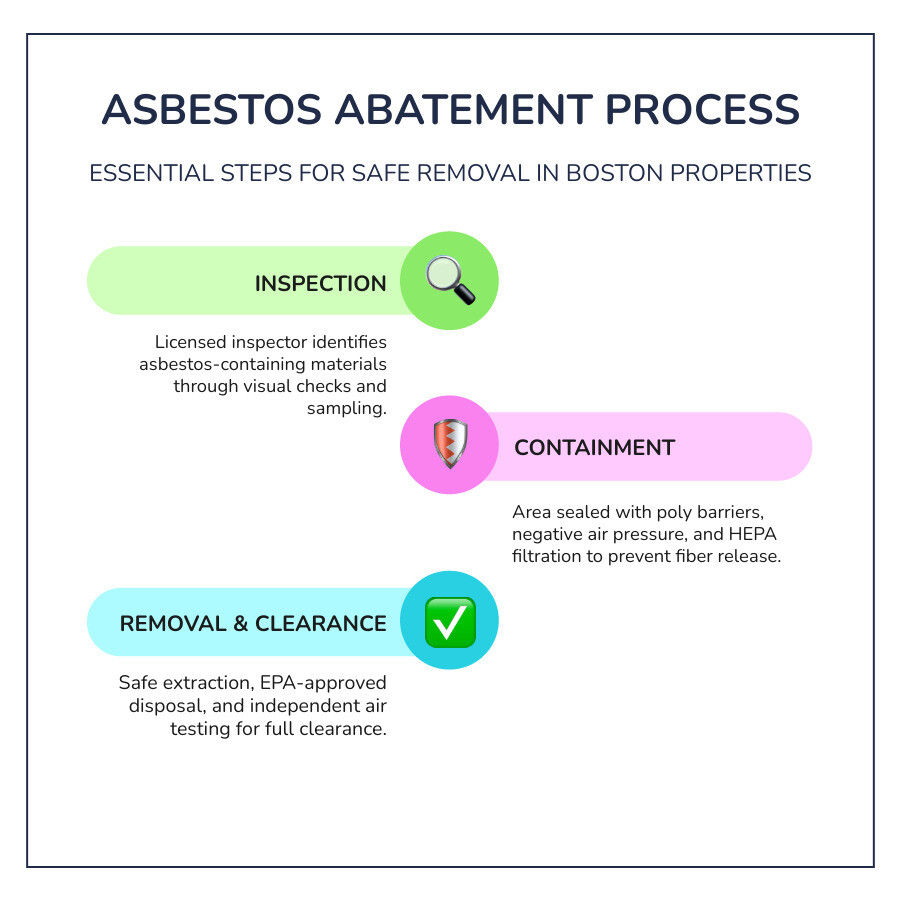
So, you’ve found asbestos. Don’t panic! The process of asbestos abatement Boston follows a very specific, highly regulated sequence to ensure total safety. Here is how we handle it at Banner Environmental Services.
1. Inspection and Planning
First, we perform a site inspection. We don’t guess; we test. Samples are sent to a certified lab to confirm the presence and type of asbestos. Once confirmed, we develop a customized abatement plan and file the necessary permits with the Massachusetts Department of Environmental Protection (MassDEP).
2. Containment and Filtration Standards
This is the most critical phase. We don’t just walk in and start pulling things down. We build a “containment zone.”
- Poly-sheeting Barriers: We seal off the work area with heavy-duty plastic sheeting.
- Negative Air Pressure: We use specialized machines to create negative pressure, ensuring that air only flows into the work area, never out into the rest of your home.
- HEPA Filtration: All air leaving the containment zone passes through High-Efficiency Particulate Air (HEPA) filters that catch 99.97% of fibers.
- Wetting Agents: We use amended water to keep the materials wet during removal, which prevents dust from rising.
Our asbestos abatement services are designed to treat your property like a laboratory—clean, controlled, and safe.
3. Safe Removal and Disposal
Our team, dressed in full-body hazmat suits and dual-cartridge respirators, carefully removes the material. It is immediately double-bagged in 6-mil poly bags, sealed, and labeled.
4. Post-Removal Clearance
We don’t just say “it’s done” and leave. We perform an in-depth cleanup using HEPA vacuums and wet wiping. Then, an independent licensed hygienist conducts air testing to ensure the air is safe for re-occupancy. Only after we receive these certified lab results do we provide the final asbestos abatement disposal documentation and clear the site. For more detail on this, check out professional asbestos removal: how it works.
Abatement vs. Removal: Choosing the Right Strategy for Your Property
A common point of confusion for our clients is the difference between “abatement” and “removal.” While often used interchangeably, they can mean different things in a technical sense.
- Asbestos Removal: This is the physical extraction and disposal of the material. It is the only permanent solution.
- Asbestos Abatement: This is a broader term that includes removal but also includes methods to manage the material safely in place.
When to Choose Encapsulation
Encapsulation involves treating the asbestos with a sealant (a thick, paint-like coating) that binds the fibers together or sticks the material to the surface so no fibers can escape.
- Pros: It’s often more cost-effective and less disruptive.
- When to use: If the asbestos is in good condition, located in an area where it won’t be disturbed (like an attic or behind a wall), and you have no plans for future renovation.
When Full Removal is Mandatory
In many cases, asbestos abatement removal is the only viable option. You must choose full removal if:
- The material is friable or already damaged.
- You are planning a renovation that will disturb the area.
- The building is slated for demolition.
- The material is in a high-traffic area where it is likely to be bumped or scraped.
A high-profile example of mandatory, large-scale removal is the Boston City Hall asbestos abatement, where public safety and structural updates made management-in-place impossible.
Cost Factors and Regulatory Compliance in Massachusetts
We know that for most Bostonians, the “bottom line” matters. While we don’t provide flat rates (because every job is unique), we can tell you what influences the price of asbestos abatement Boston.
Factors Influencing Your Estimate
- Square Footage: Larger areas naturally require more labor and disposal materials.
- Material Type: Removing floor tiles is generally less complex than removing “popcorn” ceilings or spray-on fireproofing.
- Accessibility: Asbestos in a wide-open basement is easier to access than asbestos tucked inside a crawlspace or behind a chimney flue.
- Disposal Fees: Massachusetts has strict rules about where asbestos can be dumped. It must go to EPA-approved landfills, and disposal fees are based on weight and volume.
- Emergency Services: If you have a burst pipe wrapped in asbestos insulation, you need help now. Emergency response usually carries a premium.
Massachusetts Safety Standards and Certifications
Massachusetts has some of the strictest environmental laws in the country. To operate here, a contractor must be licensed by the Department of Labor Standards (DLS).
At Banner Environmental Services, we take pride in our credentials. We are WBE (Woman Business Enterprise) and DCAMM certified, which means we’ve been vetted by the state for our financial stability and technical competence. Why it’s vital to hire a licensed asbestos contractor goes beyond just following the law—it’s about ensuring the company has the insurance and training to protect your property and your liability.
Frequently Asked Questions about Asbestos Abatement Boston
How much does asbestos removal cost in Boston?
Asbestos removal costs in Boston can vary a lot from one project to the next. The biggest factors are the type of material, how much of it is present, where it is located, how easy it is to access, and how much containment and disposal work is required. Jobs involving attic insulation, pipe wrap, flooring, or HVAC components often differ in complexity, so the only reliable way to understand cost is to get a professional inspection and written scope of work.
Can I stay in my home during the abatement process?
In many residential cases, yes—provided the work area is properly contained. However, for large-scale projects or if the asbestos is located in a central area (like the only bathroom or the kitchen), we may recommend temporary relocation for a day or two. Our containment zones are airtight, and we use air monitoring to ensure the “clean” side of the house stays that way.
How do I know if my Boston property contains asbestos?
If your home was built before 1978 (the year lead paint was banned and asbestos use began to decline sharply), you should assume it contains asbestos until proven otherwise. Visual indicators like 9×9 floor tiles or “white tape” on basement pipes are strong signs, but the only way to be 100% sure is through professional lab analysis.
Conclusion
Handling asbestos doesn’t have to be a nightmare. Whether you are a homeowner in Quincy, a property manager in Worcester, or a developer in the heart of Boston, the key is to act early and hire experts.
At Banner Environmental Services, we’ve spent over 25 years perfecting the art of environmental remediation. Our licensed, professional team ensures that every project—from a small residential pipe wrap to a massive industrial demolition—is handled with the highest level of OSHA and EPA compliance. We serve all of Massachusetts, Rhode Island, and are expanding our reach across New Hampshire, Vermont, and Maine.
Don’t let hidden hazards stall your project or threaten your health. If you suspect you have an issue, trust the team that New England relies on for safe, efficient, and compliant asbestos abatement Boston. Give us a call today, and let’s get your property back to being a safe place to live and work.