
Why Asbestos Real Estate Issues Can Derail a Property Sale
Asbestos real estate transactions are more common than most buyers and sellers expect — especially in New England, where a large share of the housing stock predates 1980.
Here’s what you need to know upfront:
- You can legally sell a home with asbestos, but if you know it is present, that fact should be disclosed.
- Asbestos that is intact and left alone is usually lower risk, but damaged or disturbed material can release dangerous fibers.
- Massachusetts does not generally require asbestos testing just to sell a house, though testing is often a smart step when suspect materials are present.
- Who pays for remediation is usually negotiable. It may be handled by the seller, the buyer, or through a price adjustment or credit.
- The biggest risks of ignoring asbestos are legal disputes, inspection problems, delayed or failed closings, and potential health exposure.
Asbestos doesn’t have to kill a real estate deal. But mishandling it — or failing to disclose it — absolutely can.
Homes built before 1980 are especially likely to contain asbestos-containing materials (ACMs) in places like pipe insulation, floor tiles, popcorn ceilings, and attic fill. When those materials are disturbed during a renovation, inspection, or demolition, microscopic fibers become airborne. At that point, what was a manageable property condition becomes a serious health and legal liability.
For property owners, buyers, agents, and managers, understanding the rules around asbestos in real estate isn’t optional — protecting the transaction, the occupants, and your own liability.
I’m Stephen Wenzel, Co-Owner and Executive Vice President of Banner Environmental Services, with over 25 years of hands-on experience in asbestos abatement, environmental compliance, and hazardous material remediation across Massachusetts and Greater New England — making me well-versed in the complexities of asbestos real estate from inspection through clearance. In this guide, I’ll walk you through everything you need to navigate asbestos in a property transaction with confidence.
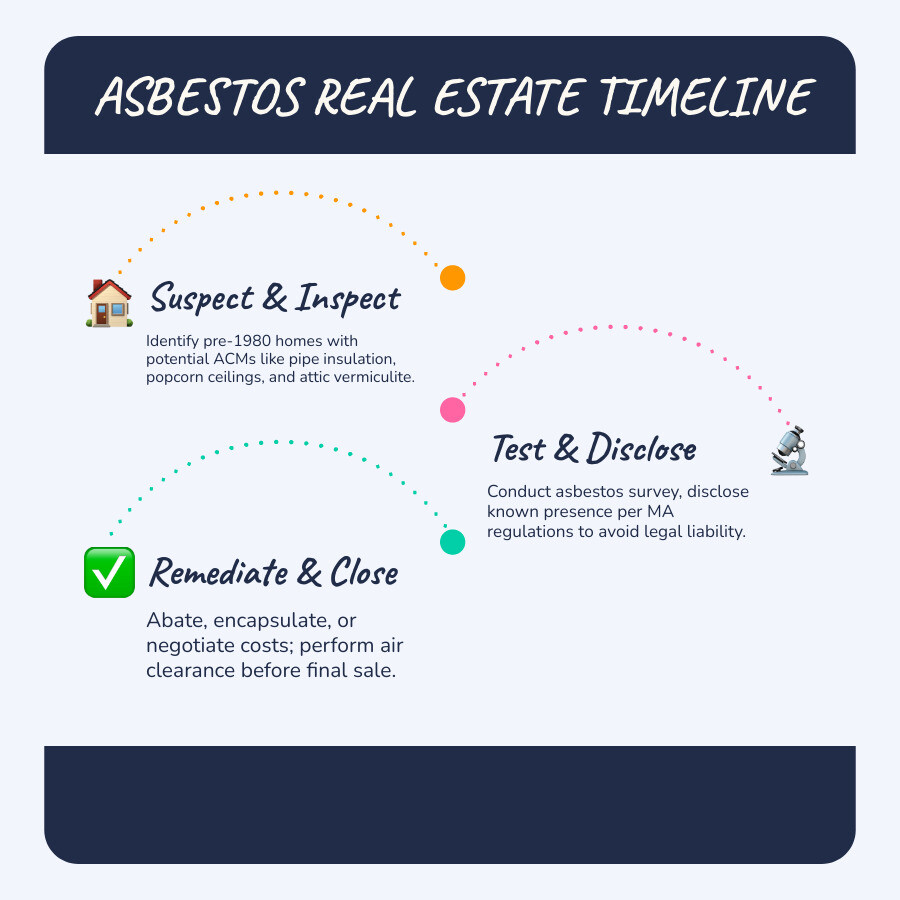
Identifying Asbestos Hazards in Residential Properties
When we talk about asbestos real estate, we aren’t just talking about a “scary word” from the past. Asbestos is a naturally occurring mineral that was the “miracle fiber” of the 20th century. It was prized for being fireproof, chemically resistant, and incredibly strong. Because of these properties, it was woven into thousands of building products.
If you are walking through a vintage New England home in Boston, Worcester, or Providence, you are likely walking past asbestos containing materials. The general rule of thumb is that if the home was built before the late 1970s, it almost certainly contains asbestos in some form.

Common Locations for Asbestos in Property Listings
As an agent or a seller, knowing where to look can save you from a “surprise” during the buyer’s home inspection. According to U.S. Environmental Protection Agency guidelines, the most common culprits include:
- Popcorn Ceilings: These textured ceilings were a staple from the 1950s through the 1980s.
- Vinyl Floor Tiles: Specifically, the 9×9 inch tiles often found in New England basements and laundry rooms are notorious for containing asbestos in both the tile and the black mastic adhesive used to glue them down.
- Pipe Lagging: This often looks like white corrugated paper or “plaster” wrapped around steam pipes in older basements. Knowing how to tell if insulation is asbestos is tricky because you can’t confirm it just by looking; however, if it’s white, fibrous, and on a pipe in a pre-1980 home, treat it as suspect.
- Attic Insulation: One of the biggest deal-killers is asbestos abatement vermiculite. This pebble-like insulation often contains tremolite asbestos. If a buyer sees this in the attic, they will likely demand a what is an asbestos survey before proceeding.
- Exterior Siding: “Transite” siding is a cement-asbestos board that is very durable but becomes a hazard if it’s cracked or being drilled into.
- HVAC Systems: Duct wrap and boiler gaskets are common hiding spots for high-percentage asbestos materials.
Navigating Massachusetts Asbestos Real Estate Disclosure and Legal Requirements
In Massachusetts, the legal landscape for asbestos real estate is governed by the MassDEP (Department of Environmental Protection) and the Department of Labor Standards (DLS). While the law doesn’t explicitly force you to test your home for asbestos before putting a “For Sale” sign in the yard, it does have very strict rules about what you must say if you do know about it.
Mandatory Disclosures for Asbestos Real Estate Transactions
Massachusetts law requires sellers to disclose “latent defects”—problems with the property that wouldn’t be obvious to a buyer but could affect health or safety. If you have a report sitting in a drawer that says your basement pipes are wrapped in asbestos, you are legally obligated to disclose that.
Failing to do so isn’t just a breach of trust; it can lead to massive penalties. Under the Massachusetts Clean Air Act, violating massachusettss clean air act regulations regarding the handling and disposal of asbestos can result in civil penalties of up to $25,000 per day per violation.
The health risks are the driving force behind these laws. A National Institute for Occupational Safety and Health report famously stated that “no evidence of a threshold or safe level of exposure has been found.” This is why buyers are so cautious. They know that while the asbestos ban history started in the late 70s, the materials didn’t just disappear from existing shelves or homes.
Cost Implications for Asbestos Real Estate Negotiations
When asbestos is discovered during a home sale, the first question is always: “How much is this going to cost me?”
Ignoring the problem usually results in the buyer asking for a massive price reduction—often much higher than the actual cost of remediation—just to cover their “risk.” We recommend being proactive. Utilizing asbestos testing services for these five reasons (including liability protection and peace of mind) can actually save the deal.
While asbestos removal can be costly, ranging from a few thousand dollars for a small pipe job to $30,000+ for whole-house abatement, it is a quantifiable number. In many New England transactions, we see sellers provide a “closing credit” or set up an “escrow holdback” where the funds for remediation are set aside from the sale proceeds to be paid directly to a licensed contractor like us after closing.
Remediation Strategies: Removal vs. Encapsulation
If the inspection report comes back positive, you have choices. You don’t always have to rip everything out. In asbestos real estate, we look at the condition of the material first.
The process of asbestos abatement generally falls into three categories:
Removal means taking the asbestos-containing material out of the property entirely, which is usually the right move when materials are damaged or when renovation or demolition will disturb them. Encapsulation means applying a specialized sealant over the material to help keep fibers from becoming airborne, and it is often considered when items like pipe insulation or textured ceilings are still intact and unlikely to be disturbed. Enclosure means covering or isolating the asbestos behind a durable barrier, such as installing new material over old asbestos flooring, and it can work well for surfaces like floor tiles or wall panels that remain in stable condition.
Understanding professional asbestos removal and how it works is vital for sellers. It involves sealing off the area with heavy plastic (containment), using HEPA-filtered air scrubbers to create negative pressure, and ensuring asbestos abatement disposal happens at a licensed hazardous waste facility. Severity skipping steps in this process can lead to contamination of the entire home, which is a nightmare for a pending sale.
Managing Asbestos During the Sale Process
If you decide to remediate during the sale, timing is everything. A standard asbestos abatement survey and testing phase can take 1-2 weeks, and the work itself can take a few days to a week.
One of the biggest mistakes we see is improper asbestos removal by a “handyman” or the homeowner themselves. Please, dont put your family at risk with improper asbestos removal. Not only is it a health hazard, but if a buyer finds out the work was done without a license or permits, they can walk away from the deal, and you may face legal action.
Always ensure that after the work is done, an independent lab performs air clearance testing. You can find accredited labs on the NVLAP web site to ensure the air is safe for the new family to move in.
Frequently Asked Questions about Asbestos in Property Sales
As experts in asbestos abatement removal, we hear the same concerns from real estate professionals every week. Here are the straight answers to the most common questions.
Can you legally sell a house with asbestos in Massachusetts?
Yes, absolutely. There is no law in Massachusetts, Rhode Island, or New Hampshire that prohibits the sale of a home containing asbestos. The law focuses on disclosure and safe handling. As long as you aren’t hiding a known hazard, you can sell the property “as-is.” However, most mortgage lenders (especially for FHA or VA loans) may require damaged asbestos to be repaired or removed before they will fund the loan.
Is asbestos dangerous if left undisturbed in a home?
Generally, no. Asbestos is only a health risk when it is “friable,” meaning it can be crumbled or reduced to powder by hand pressure, releasing fibers into the air. If your floor tiles are intact and you aren’t sanding them, they aren’t hurting anyone. The danger arises during “disturbances”—like a buyer wanting to pull up old carpet and accidentally shredding the asbestos tiles underneath.
Who is responsible for asbestos abatement: seller or buyer?
This is entirely a matter of negotiation. In a “seller’s market,” a seller might insist the buyer takes the home as-is. In a more balanced market, buyers often ask for the seller to pay for pain free abatement before closing. We often work with both parties to provide accurate quotes that can be used as a “credit” at the closing table, allowing the transaction to move forward without delay.
Conclusion
Asbestos doesn’t have to be a deal-breaker. In fact, with 25+ years of experience, we’ve seen that the best way to handle asbestos real estate issues is with total transparency and professional intervention.
Whether you are in Boston, Providence, Nashua, or anywhere across New England, Banner Environmental Services is here to help you get to the closing table safely. We are a WBE and DCAMM certified firm, meaning we meet the highest standards for state and federal projects. Our team is fully licensed and insured, ensuring that every project remains in 100% compliance with OSHA and EPA regulations.
Don’t let a “positive” asbestos test kill your commission. From the initial asbestos abatement testing and removal services to the final air clearance, we provide the documentation you need to prove the home is safe.
Need a quote for a pending sale? Contact Banner Environmental Services today. We’ll help you clear the air—and the title.