
Why Asbestos Testing in New Bedford Properties Shouldn’t Wait
Asbestos testing for New Bedford, MA property owners is straightforward to arrange — here’s a quick overview of what’s involved:
Quick Answer: Asbestos Testing in New Bedford
| Step | What Happens |
|---|---|
| 1. Schedule a survey | A licensed inspector visits your property |
| 2. Visual inspection | Surveyor identifies suspect materials |
| 3. Bulk sampling | Small samples collected from potential ACMs |
| 4. Lab analysis | Samples tested using PLM or XRF methods |
| 5. Report issued | Results confirm presence, type, and condition of asbestos |
| 6. Next steps | Encapsulation, removal, or ongoing management recommended |
If your property was built before 2000, there’s a real chance it contains asbestos-containing materials (ACMs). Asbestos was widely used in construction for decades — in insulation, floor tiles, ceiling coatings, roofing, and more — before its dangers became fully understood.
The problem? Disturbing asbestos without knowing it’s there is one of the most common and preventable causes of serious long-term illness in property owners and construction workers.
Inhaled asbestos fibers can cause mesothelioma, asbestosis, and lung cancer — diseases that can take decades to appear but are often fatal. Testing before any renovation or demolition work is the critical first step in protecting everyone on site.
Whether you own a home, manage a commercial building, or oversee an industrial facility in the New Bedford area, knowing what’s in your walls before work begins isn’t just smart — in many cases, it’s required by law.
Why Asbestos Testing in New Bedford is Essential for Property Owners
When we talk about asbestos, we aren’t just talking about an old building material; we are talking about a significant health legacy. Asbestos is a naturally occurring mineral that was the “darling” of the construction industry until the late 1970s and 1980s. It was cheap, incredibly durable, and virtually fireproof. However, those same durable fibers are what make it so dangerous.

When asbestos-containing materials (ACMs) are disturbed—whether you’re pulling up old floor tiles or knocking down a lath-and-plaster wall—microscopic fibers are released into the air. These fibers are jagged and needle-like. Once inhaled, they settle deep in the lung tissue or the lining of the chest and abdomen.
The health risks are severe and often delayed by 20 to 50 years:
- Mesothelioma: A rare and aggressive cancer almost exclusively linked to asbestos exposure.
- Asbestosis: A chronic lung disease caused by scarring of lung tissue, making it difficult to breathe.
- Lung Cancer: Asbestos exposure significantly increases the risk of lung cancer, especially for smokers.
In New Bedford, MA, many of our residential sites, commercial buildings, and industrial warehouses were constructed during the height of asbestos use. If your property was built before 1990 (and especially before 1980), you should assume asbestos is present until a professional proves otherwise. There are at least five reasons why professional testing is the only safe way to move forward with a project.
Common Locations for Asbestos in Bedford Homes
You might walk past asbestos every day without realizing it. It isn’t always hidden behind a wall; sometimes it is the wall. Here are the most common places we find ACMs during asbestos testing New Bedford inspections:
- Floor Tiles and Adhesive: Those 9×9 vinyl tiles common in older basements almost always contain asbestos, as does the black “mastic” glue used to stick them down.
- Artex and Textured Ceilings: Popular in mid-century homes, many “popcorn” or decorative plaster finishes used white asbestos for texture.
- Roofing Sheets and Shingles: Transite roofing and certain types of asphalt shingles used asbestos for weatherproofing.
- Insulation: This includes “vermiculite” attic insulation (which often looks like shiny pebbles) and loose-fill insulation.
- Pipe Lagging: The white, chalky wrap around old steam pipes is one of the most friable (easily crumbled) and dangerous forms of asbestos.
- Garage Roofs and Sheds: Corrugated cement sheets used on outbuildings are a frequent source of asbestos.
Understanding Different Types of Asbestos Surveys
Not every property needs the same level of inspection. The type of survey we recommend depends entirely on what you plan to do with the building. Following standard guidance, we typically categorize surveys into two main types.
| Feature | Management Survey | Refurbishment/Demolition Survey |
|---|---|---|
| Purpose | To manage ACMs during normal occupation | To locate all ACMs before construction work |
| Intrusiveness | Low (mostly visual/surface sampling) | High (fully intrusive, involves opening walls) |
| Requirement | Ongoing for commercial/public buildings | Mandatory before any renovation/demo |
| Goal | Ensure ACMs are in good condition | Identify everything that needs removal |
Management Surveys for Ongoing Safety
A Management Survey is designed to ensure that nobody is at risk during the day-to-day use of a building. We perform a visual inspection to locate any suspect materials and assess their condition. If the material is in good shape and isn’t being disturbed, it often doesn’t need to be removed. Instead, it can be “managed” through periodic reinspection to ensure it hasn’t started to deteriorate or release fibers.
Refurbishment and Demolition Surveys
If you are planning to swing a sledgehammer, a Management Survey isn’t enough. You need a Refurbishment and Demolition (R&D) Survey. This is a much more “intrusive” process. We look behind walls, under floorboards, and inside ceiling voids to find every bit of asbestos that could be disturbed by your contractors. This ensures that a renovation doesn’t accidentally turn into an environmental crisis.
Legal Requirements and Local Regulations in New Bedford, MA
Navigating the legalities of asbestos can be a headache, but compliance is non-negotiable. In the United States, the EPA and OSHA set the baseline, but local mandates in places like Bedford, MA, and Bedford, NH, add extra layers of protection.
In New England, strict rules govern how asbestos is identified and handled. For example, in New Hampshire, the Env-A 1800 rules dictate licensing for asbestos professionals and specific work practices that must be followed.
Regulatory Differences: UK vs. US Bedford Locations
While this guide focuses on our service areas in New England, it’s worth noting that “Bedford” is a popular name!
- Bedford, MA & NH: These areas fall under EPA and state-specific regulations (like MassDEP or NHDES). In Massachusetts, for instance, you cannot get a demolition permit without a licensed asbestos inspector signing off.
- Bedford, UK: Our friends across the pond follow the Control of Asbestos Regulations 2012 (CAR 2012) and HSG264 guidance.
Regardless of which Bedford you are in, the core principle is the same: you must identify the hazard before you disturb it.
Permitting and Health Department Mandates
In many New England towns, the local Health Department is the gatekeeper for construction. In Bedford, MA, for example, the Health Department requires a completed hazardous materials checklist before any demolition or renovation permit is issued. This includes:
- A report from a licensed asbestos inspector.
- Lab data confirming the presence or absence of ACMs.
- If asbestos is found, documentation of a DEP notification and disposal receipts from a licensed landfill.
Failure to provide this can result in heavy fines and immediate “stop-work” orders on your project.
The Step-by-Step Process of Asbestos Testing
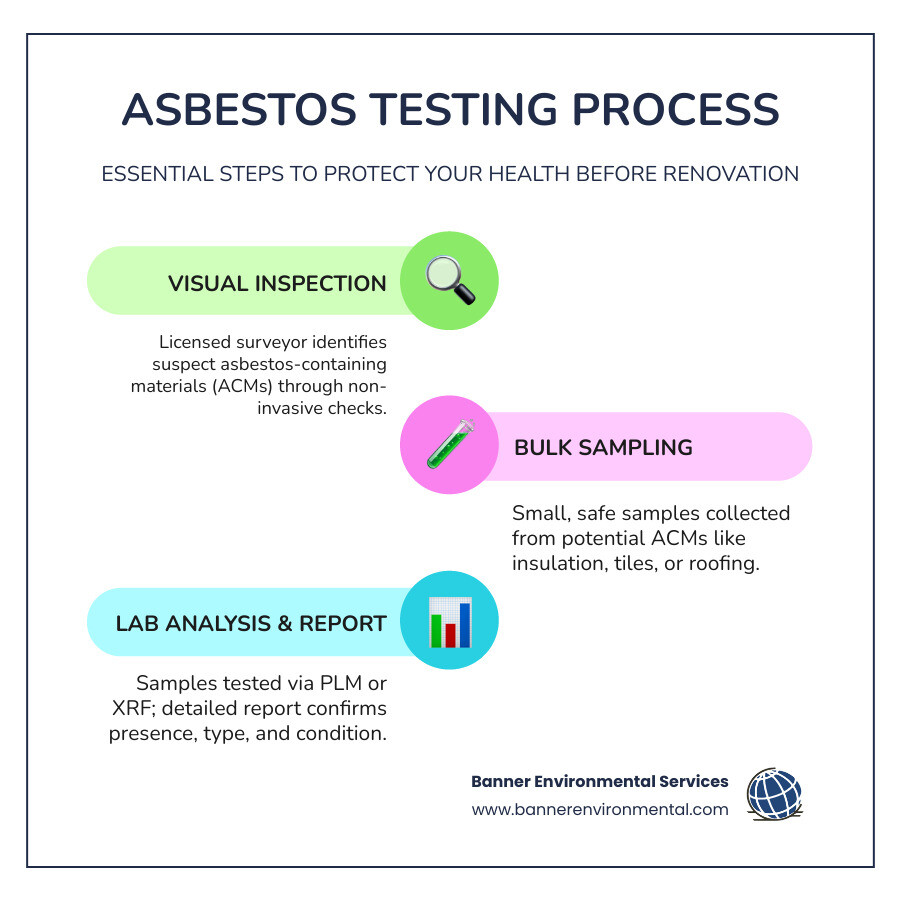
So, what actually happens when we show up for asbestos testing Bedford? We don’t just walk around with a clipboard; it’s a scientific process.
Professional Asbestos Testing Bedford Services
When we arrive, we follow a strict sampling protocol to prevent cross-contamination.
- Visual Inspection: We identify “homogenous areas”—groups of materials that look the same and were likely installed at the same time.
- Bulk Sampling: We take small pieces (about the size of a postage stamp) of the suspect material. For friable materials like pipe insulation, we use “wet methods” to ensure no dust escapes during the sampling.
- Lab Analysis: The samples are sent to an accredited laboratory. They use Polarized Light Microscopy (PLM) to identify the specific type of asbestos (like Chrysotile, Amosite, or Crocidolite) and its percentage in the material. In some cases, we use X-ray Fluorescence (XRF) for specialized analysis.
Our team holds the necessary certifications—including DCAMM and WBE certifications in Massachusetts—to ensure that our testing results are legally defensible and scientifically accurate.
Timelines and Reporting
We know that construction schedules are tight. “Time is money” isn’t just a cliché in the building world.
- Turnaround Time: Standard lab results usually take 48 hours to a week.
- Reports: Once the lab results are in, we issue a comprehensive report. This includes the location of ACMs, their condition, and our professional recommendations for next steps.
- Emergency Testing: For situations where a pipe has burst or a wall has been accidentally breached, we offer emergency response services to get you answers—and safety—immediately.
Frequently Asked Questions about Asbestos Testing Bedford
How much does an asbestos survey cost?
While we don’t provide flat rates (because every building is different), we can explain what drives the price. We aim to be as transparent as possible so there are no surprises on your invoice.
Cost Factors for Asbestos Testing Bedford
- Building Size: A 1,000-square-foot ranch takes less time than a 50,000-square-foot warehouse.
- Property Age: Older buildings often have multiple layers of flooring or “re-muddied” joints that require more samples.
- Number of Samples: The more materials we have to test, the higher the lab fees.
- Usage Type: Commercial sites often require work to be done after hours, which can affect the cost.
- Accessibility: If we need scaffolding or specialized equipment to reach a ceiling or crawlspace, that will be reflected in the quote.
What should I do if asbestos is detected?
First, don’t panic. If the asbestos is in good condition and left alone, it poses very little risk. However, if it’s in the way of your renovation, you need a plan for asbestos abatement.
Do not attempt DIY removal. This is the most common way people expose themselves and their families to high concentrations of fibers. Professional abatement involves:
- Setting up “negative pressure” enclosures.
- Using HEPA-filtered vacuums and air scrubbers.
- Properly bagging and labeling waste for hazardous disposal.
- Final air clearance testing to prove the area is safe to re-enter.
In some cases, we may recommend encapsulation—sealing the asbestos with a specialized coating—rather than full removal, depending on your long-term plans for the property.
Conclusion
Renovating a property in Bedford is an exciting milestone, but it shouldn’t come at the cost of your health or legal standing. At Banner Environmental Services, we bring over 25 years of experience to every project. As a WBE/DCAMM-certified company, we pride ourselves on a professional, licensed team that ensures every job is OSHA and EPA-compliant.
We serve all of New England, from our roots in Massachusetts and Rhode Island to our expanding services in New Hampshire, Vermont, and Maine. Whether you need a simple test for a kitchen remodel or a full pre-demolition survey for a commercial site, we are here to provide the unbiased, expert data you need to stay safe.
If you suspect your property might have hidden hazards like vermiculite, don’t guess—get the facts. Check out our vermiculite removal services or contact us today to schedule your Bedford asbestos inspection. Your safety is our priority.