
Why Asbestos Inspections Could Be the Most Important Step You Take Before Any Building Work
Asbestos inspections are a critical first step for any building owner, manager, or developer before renovation, demolition, or property purchase.
Here’s what you need to know at a glance:
| Question | Quick Answer |
|---|---|
| What is an asbestos inspection? | A certified professional surveys your building to locate and identify asbestos-containing materials (ACMs) |
| Who needs one? | Homeowners (pre-1980 buildings), schools, commercial property owners, contractors |
| When is it required? | Before renovation, demolition, property sale, or as part of ongoing school compliance |
| Who performs it? | A state-certified asbestos inspector |
| What happens after? | You get a written report with findings, condition assessments, and next steps |
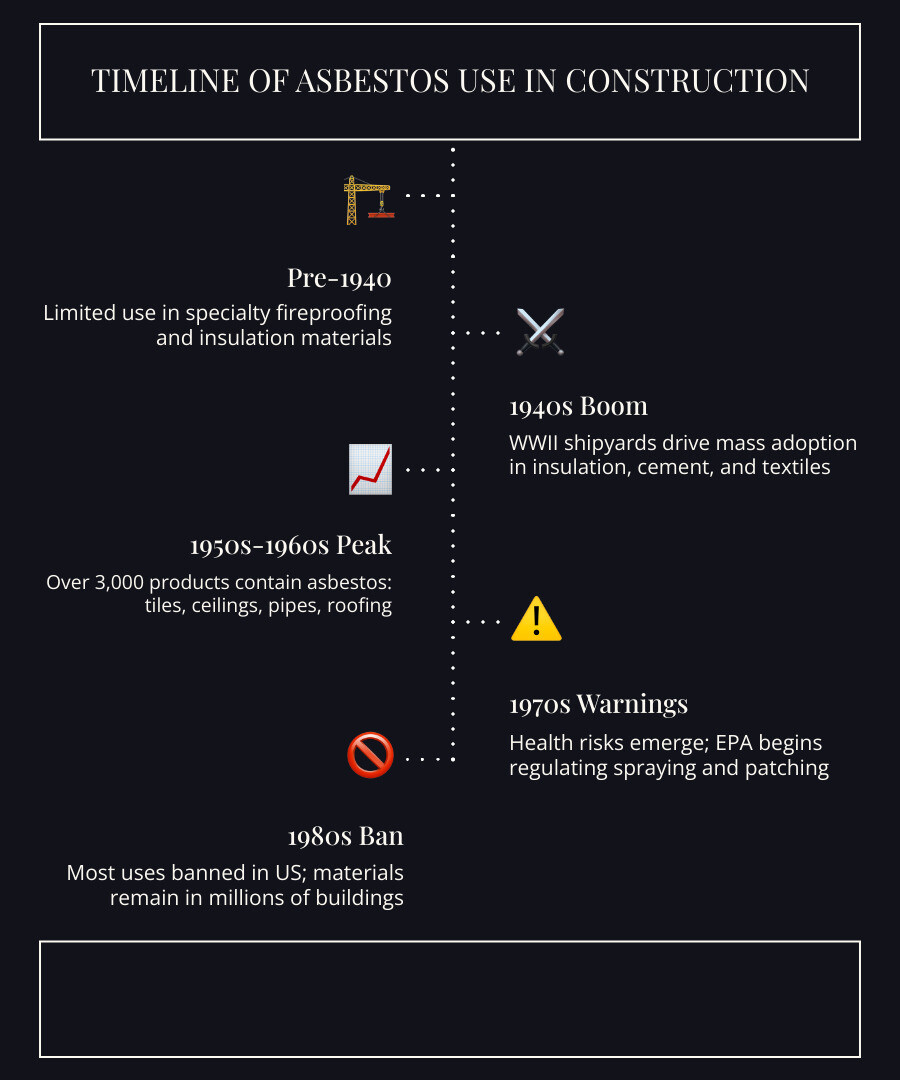
Asbestos was widely used in thousands of building materials from the 1940s through the 1970s. It was cheap, fire-resistant, and effective as insulation. The problem? When those materials are disturbed — during a renovation, a demo project, or even routine maintenance — microscopic fibers become airborne. You can’t see them. You can’t smell them. And breathing them in can cause serious diseases including lung cancer, mesothelioma, and asbestosis, sometimes not appearing until decades after exposure.
That’s why waiting until something goes wrong is not an option.
Whether you’re a homeowner planning a remodel, a school administrator managing compliance, or a developer preparing a site for demolition, knowing what’s in your building before work begins protects your occupants, your liability, and your investment.
I’m Stephen Wenzel, Co-Owner and Executive Vice President of Banner Environmental Services, and with over 25 years of hands-on experience in asbestos inspections, abatement planning, and environmental compliance across New England, I’ve seen the risks of skipping this step. In this guide, I’ll walk you through everything you need to know to make an informed decision.
Understanding the Scope of Asbestos Inspections
When we talk about an asbestos inspection (often called an asbestos survey), we aren’t just taking a quick look around with a flashlight. It is a systematic, documented process designed to identify the presence, location, and quantity of Asbestos-Containing Materials (ACMs).
The goal is to provide a clear roadmap for the building owner. If we find asbestos, we need to know its condition. Is it “friable”—meaning it can be crumbled by hand pressure and is therefore more likely to release fibers? Or is it “non-friable,” like a hard floor tile that only becomes dangerous if you start grinding or sanding it? Understanding What is an Asbestos Survey? is the first step in managing your property’s health.
Types of Asbestos Surveys
Not every building needs the same level of scrutiny. The type of survey we perform depends entirely on your goals:
- Management Surveys: This is the standard for buildings in normal use. We locate ACMs that could be damaged or disturbed during normal occupancy or routine maintenance.
- Refurbishment Surveys: If you are planning to renovate a specific wing of a hospital or a floor of an office building, we conduct a targeted survey of that area. This is more intrusive than a management survey because we need to look behind walls and under floors.
- Demolition Surveys: These are the most intensive. Before a building is torn down, we must identify every scrap of asbestos. This involves “destructive” sampling—breaking into sealed voids, ducts, and structural components to ensure nothing is missed.
- Pre-purchase Inspections: Common in New England real estate, these help buyers understand potential future costs before they sign on the dotted line.
- Re-inspection Surveys: For buildings with known asbestos, periodic checks are required to ensure the material hasn’t deteriorated.
For more detailed regulatory guidance, you can review The duty to manage asbestos in buildings: Arrange an asbestos survey – HSE, which outlines the responsibilities of building dutyholders.
Common Materials Targeted During Asbestos Inspections
Asbestos is a bit of a “chameleon” in the construction world. It was added to over 3,000 different building products. During our asbestos inspections, we look for:
- Thermal System Insulation (TSI): This includes pipe wraps, boiler blankets, and duct insulation. If you see “white tape” or “plaster-like” elbows on old pipes, there’s a high probability of asbestos.
- Surfacing Materials: Spray-applied fireproofing on steel beams, troweled-on plaster, and acoustic “popcorn” ceilings.
- Miscellaneous Materials: This is a catch-all for floor tiles (especially the old 9×9 inch ones), ceiling tiles, roofing shingles, transite siding, and even the joint compound used on drywall.
- Vermiculite: Often found in attics, this pebble-like insulation can be contaminated with asbestos fibers.
Learning How to Tell if Insulation is Asbestos can be tricky for the untrained eye, which is why professional sampling is non-negotiable.

Why Asbestos Inspections are Legally Required
In property management, “I didn’t know” isn’t a legal defense. Federal and state regulations are very clear about when and why you must test for asbestos. This isn’t just about safety; it’s about avoiding massive fines and legal liability.
The EPA’s National Emission Standards for Hazardous Air Pollutants (NESHAP) requires that a thorough inspection be conducted before any renovation or demolition of a regulated facility. This applies to most commercial buildings, large residential complexes, and public structures. Furthermore, OSHA requires employers to identify ACMs to protect workers from exposure.
There are Asbestos Testing Services: Five Reasons why you should never skip this step, ranging from legal compliance to protecting the long-term value of your property. You can find more about NESHAP Pre-renovation/Demolition Surveys on the EPA’s official compliance pages.
Professional Asbestos Inspections for Schools and Public Buildings
Schools are in a category of their own due to the The Asbestos Hazard Emergency Response Act (AHERA). This federal law requires public school districts and non-profit private schools to:
- Perform an original inspection to identify ACMs.
- Re-inspect all known or assumed asbestos every three years using an accredited inspector.
- Conduct “routine surveillance” every six months (this can be done by a trained custodian).
- Maintain an updated Asbestos Management Plan that is available to parents and teachers within five business days of a request.
At Banner Environmental, we help New England schools navigate these complex AHERA requirements, ensuring that “Designated Persons” are properly trained and that all documentation is airtight.
Scheduling Asbestos Inspections Before Renovation or Demolition
If you are planning to swing a sledgehammer, you need an inspection first. Most states in New England, including Maine and New Hampshire, require that a certified asbestos inspector evaluate the property before work begins.
Even if the inspection comes back negative, many jurisdictions require a 10-day notification period to the state environmental agency before demolition starts. If asbestos is found, it must be removed by a licensed abatement contractor before the general renovation can proceed. This prevents the accidental release of fibers that could contaminate the entire job site—a mistake that can cost tens of thousands of dollars in cleanup fees.
The Technical Process: Sampling and Lab Analysis
You might wonder, “Can’t you just look at it and tell?” The answer is no. Even the most experienced inspector cannot confirm the presence of asbestos with the naked eye. We use a scientific approach to ensure accuracy.
We group materials into “homogeneous areas”—materials that look the same, were installed at the same time, and have the same texture. We then use what we call the “chocolate chip cookie theory.” Just because you take a bite of a cookie and don’t hit a chocolate chip doesn’t mean the cookie doesn’t have them. Similarly, asbestos isn’t always distributed evenly. That’s why we take multiple samples:
- Surfacing Materials: Usually 3 to 7 samples depending on the square footage.
- TSI (Pipe Insulation): At least 3 samples per homogeneous area.
- Miscellaneous: At least 1 or 2 samples, though more are often better for certainty.
The samples are then sent for Asbestos Abatement / Testing at an accredited laboratory.
Laboratory Standards and Accreditation
Not all labs are created equal. For school samples under AHERA, the law mandates the use of labs accredited by the National Institute of Standards and Technology (NIST) under the National Voluntary Laboratory Accreditation Program (NVLAP).
There are three main ways labs look at your samples:
- Polarized Light Microscopy (PLM): The standard method for bulk samples (like a piece of floor tile). It uses polarized light to identify the specific mineral fibers.
- Transmission Electron Microscopy (TEM): The “gold standard.” It can see fibers that are too small for PLM and is often used for air samples or to confirm “none detected” results in complex materials like floor tiles.
- Phase Contrast Microscopy (PCM): Primarily used for air monitoring on job sites to count the total number of fibers in the air, though it can’t distinguish between asbestos and, say, fiberglass.
What to Expect in a Comprehensive Survey Report
Once the lab work is done, we don’t just hand you a stack of papers and say “good luck.” A professional survey report should be a clear, actionable document. It must include:
- The inspector’s name and state license number.
- A detailed inventory of all materials sampled.
- A map or diagram showing where samples were taken.
- The laboratory’s accredited results.
- An assessment of the material’s condition (e.g., “damaged,” “significant potential for damage”).
- Specific recommendations for management or removal.
| Feature | Management Survey | Demolition Survey |
|---|---|---|
| Purpose | Ongoing safety during building use | Pre-demo safety and compliance |
| Intrusiveness | Minimal; targets visible areas | High; involves breaking into walls/voids |
| Occupancy | Building can be occupied | Building must be vacant |
| Scope | ACMs likely to be disturbed | All ACMs throughout the structure |
Residential vs. Commercial Property Considerations
The rules change slightly depending on what kind of building you own. For commercial real estate, asbestos inspections are a standard part of “due diligence” during a sale. No bank wants to finance a building that has a hidden six-figure abatement liability.
In the residential world, the focus is often on older New England homes. If your home was built before 1950, there is a very high probability of asbestos in the plaster, insulation, or flooring. Even homes built up into the 1980s are at risk. We often work with homeowners who are planning a kitchen remodel or a basement finish and want to ensure their family isn’t breathing in legacy dust. You can learn more about our Asbestos Abatement / Survey services for residential properties.
DIY Risks and Homeowner Exemptions
In states like New Hampshire and Massachusetts, there are sometimes exemptions that allow a homeowner to remove asbestos from their own single-family, owner-occupied home. However, just because you can doesn’t mean you should.
DIY asbestos removal is incredibly risky. Without professional-grade HEPA vacuums, negative air machines, and specialized suits, you are likely to contaminate your entire home. Professional inspectors carry professional liability insurance for a reason—it’s a high-stakes job. If you do choose to handle small amounts yourself, you must follow strict “wetting” techniques to keep dust down and package the waste in specific, labeled bags for disposal at permitted facilities. For more on this, the New Hampshire Department of Environmental Services provides a guide on how to Breathe Easy: Managing Asbestos During Home Projects.
Frequently Asked Questions about Asbestos Inspections
How long does an asbestos inspection take and what is the cost?
The duration of an inspection depends on the size and complexity of the building. A standard three-bedroom home might take 2 to 4 hours, while a large industrial complex could take several days.
As for the cost, it varies based on:
- The square footage of the building.
- The number of samples required (lab fees are usually per-sample).
- The turnaround time (standard is 3-5 days, but “rush” analysis is available for a premium).
- The type of survey (demolition surveys cost more due to the labor involved in destructive sampling).
While we don’t provide flat pricing here, we always provide a detailed quote before starting. You can use this Asbestos – Self-Inspection Checklist from OSHA to get an idea of what we’ll be looking for.
Who is qualified to perform an asbestos inspection?
You should only hire an inspector who is state-licensed and has completed training under the EPA’s Model Accreditation Plan (MAP). In our region, each state (MA, RI, NH, etc.) has its own licensing board.
When vetting a company, ask for:
- Current State Licenses: For both the firm and the individual inspector.
- Proof of Insurance: Specifically “Professional Liability” or “Errors and Omissions” insurance for asbestos work.
- References: Experience in your specific building type (e.g., historical homes vs. industrial plants).
You can check the Asbestos Inspector List – Rhode Island Department of Health or your local state agency to verify credentials.
What happens if asbestos is found on my property?
Finding asbestos isn’t a death sentence for your project. If the material is in good condition and isn’t in an area where it will be disturbed, we often recommend “in-place management.” This involves creating an Operations and Maintenance (O&M) plan to monitor the material periodically.
If the material is damaged or in the way of construction, you have a few options:
- Encapsulation: Covering the asbestos with a specialized sealant.
- Enclosure: Building a permanent airtight barrier around it.
- Abatement (Removal): The permanent solution. This must be done by a licensed abatement team (like us!) using strict containment protocols.
Conclusion
At Banner Environmental Services, we believe that peace of mind is the most valuable part of any construction project. With over 25 years of experience serving Massachusetts, Rhode Island, and the rest of New England, our team is dedicated to keeping your environment safe and your project compliant.
We are a WBE and DCAMM-certified firm, meaning we meet the highest standards for professional service and safety. Whether you’re in Boston, Providence, Manchester, or anywhere in between, we have the local expertise to handle your asbestos inspections with precision.
Don’t leave the health of your family or your employees to chance. Schedule your professional asbestos survey today and breathe easy knowing your property is in expert hands.