
Why Hiring the Right Asbestos Removal Contractor Protects Your Health and Property
An asbestos removal contractor is a licensed professional trained to safely identify, contain, and dispose of asbestos-containing materials (ACMs) in buildings. Here’s what you need to know before hiring one:
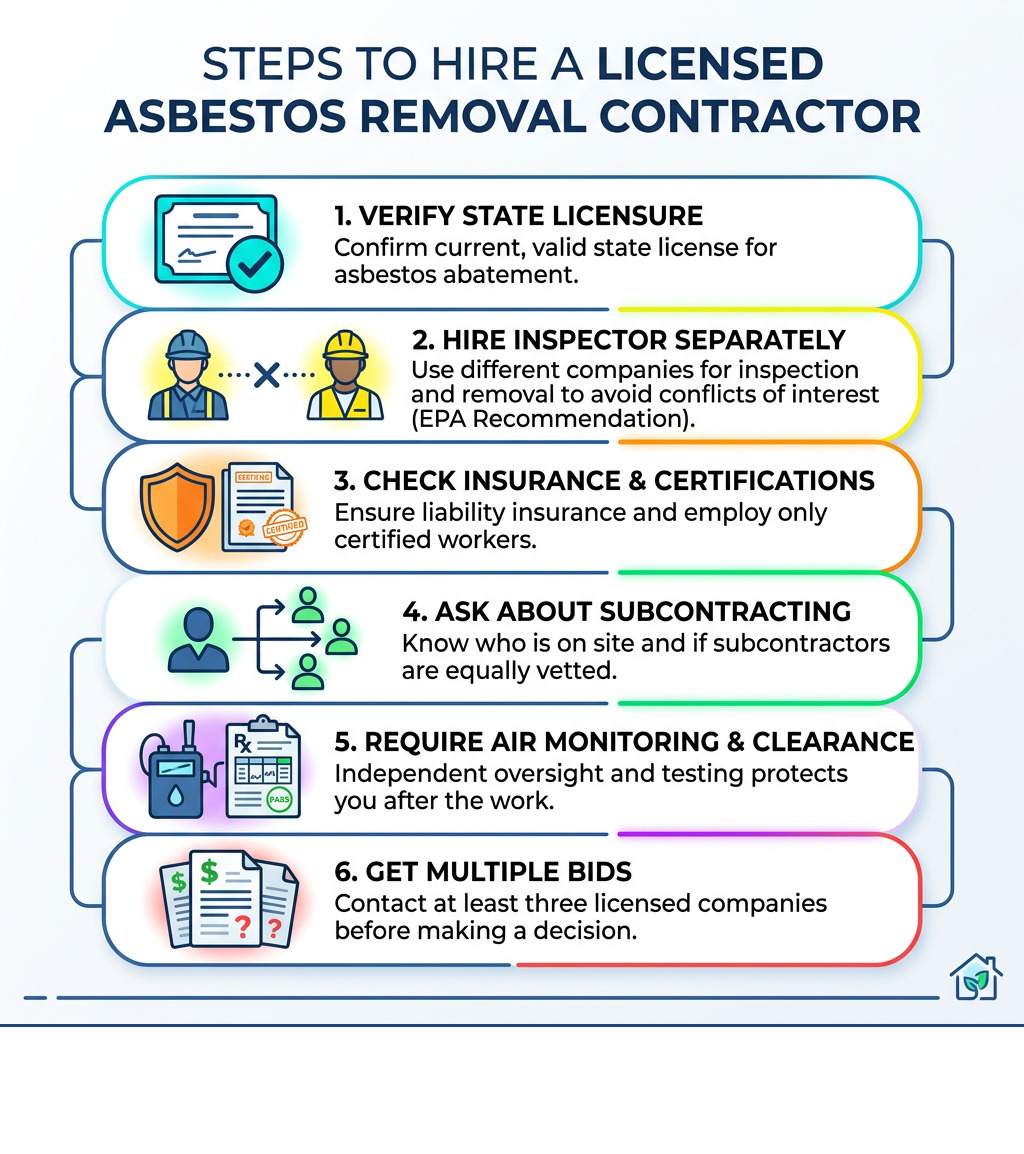
How to hire the right asbestos removal contractor:
- Verify state licensure – Confirm the contractor holds a current, valid asbestos abatement license in your state
- Hire your inspector separately – The EPA recommends using a different company for inspection and removal to avoid conflicts of interest
- Check insurance and certifications – The contractor must carry liability insurance and employ certified workers
- Ask about subcontracting – Know who will actually be on your job site and whether subs are equally vetted
- Require air monitoring and clearance testing – Independent oversight protects you after the work is done
- Get multiple bids – Contact at least three licensed companies before making a decision
Asbestos isn’t just a relic of the past. It was used in more than 3,000 different building materials before the 1980s. That means millions of homes, schools, and commercial buildings still contain it today. When those materials are disturbed during renovation or demolition, microscopic fibers become airborne. Once inhaled, those fibers can stay in the lungs permanently and lead to serious diseases like mesothelioma and asbestosis.
Choosing the wrong contractor doesn’t just put workers at risk. It puts you, your occupants, and your property at risk — and can expose you to serious legal liability.
I’m Stephen Wenzel, Co-Owner and Executive Vice President of Banner Environmental Services, with more than 25 years of hands-on experience working as an asbestos removal contractor and overseeing abatement projects across Massachusetts, Rhode Island, and the Greater New England region. In this guide, I’ll walk you through everything you need to know to hire the right team with confidence.
Understanding the Risks and Locations of Asbestos
When we talk about asbestos, we aren’t just talking about an old building material; we’re talking about a significant health concern. Asbestos is a group of naturally occurring fibrous minerals prized for their incredible tensile strength and heat resistance. Unfortunately, those same microscopic fibers that make it a great insulator are devastating to the human body.
If these materials are crushed, sawed, or even bumped during a DIY project, they release inhalable fibers. Once inside the lungs, they cause permanent scarring and can lead to fatal conditions like mesothelioma—a cancer specifically linked to asbestos exposure. Because these fibers are “persistent,” meaning the body cannot easily expel them, the risk is cumulative over a lifetime.
Common Areas for Asbestos in Older Buildings
If your property in Boston, Providence, or anywhere across New England was built before the 1980s, there is a high probability it contains Asbestos containing materials. At Banner Environmental Services, we frequently encounter it in:
- Popcorn ceilings: That textured “cottage cheese” look was a staple for decades and often contains 1% to 10% asbestos.
- Vinyl flooring: Both the tiles themselves and the “black mastic” adhesive used to glue them down are common culprits.
- Exterior Siding: Many older New England homes feature Asbestos siding which is durable but dangerous if cracked or drilled.
- Windows: It’s hidden in plain sight within Asbestos window glazing used to seal glass panes.
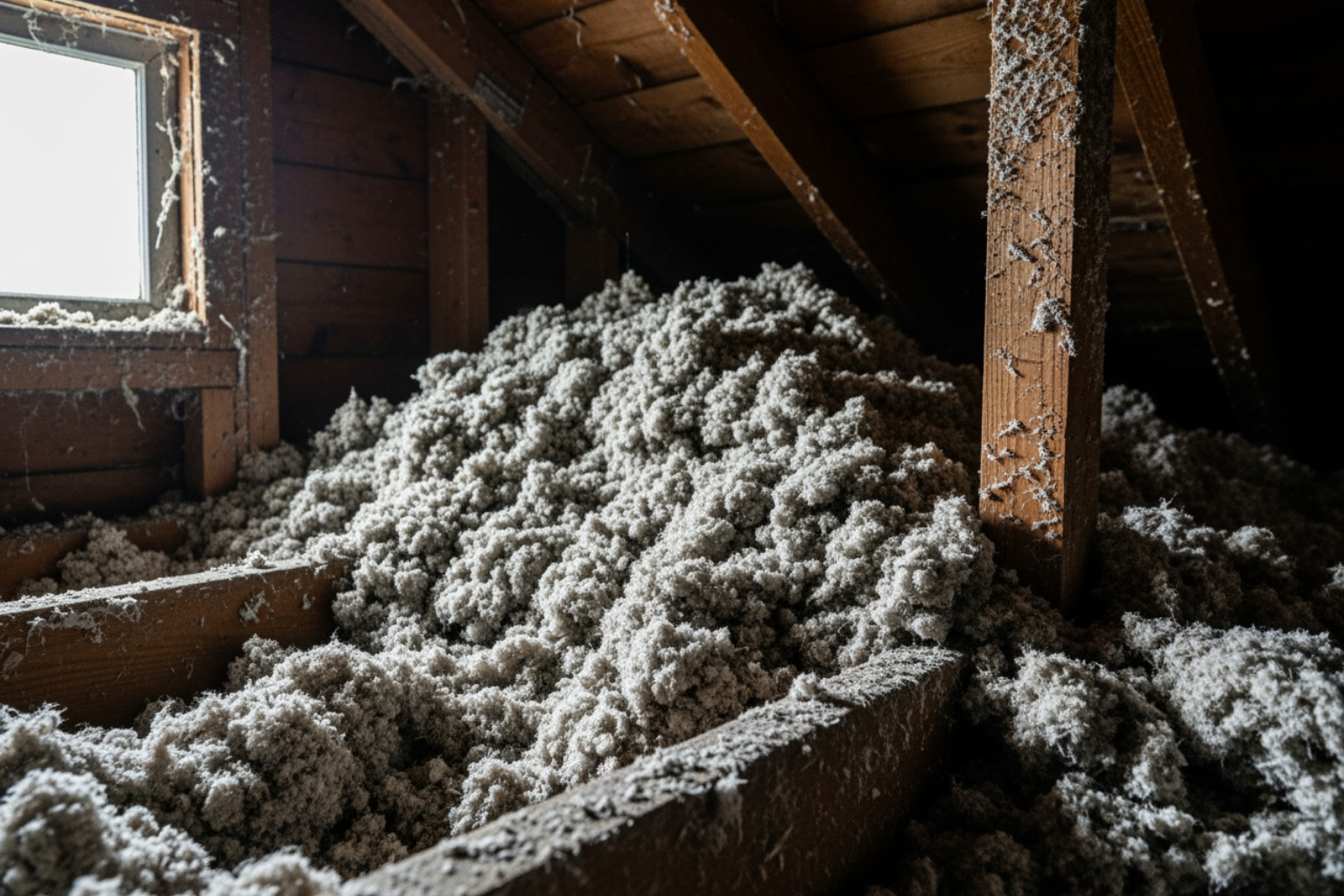
- Insulation: Specifically vermiculite insulation, which often looks like small pebbles or “puffed” stones in attics. Knowing how to tell if insulation is asbestos usually requires a professional lab test, as you cannot tell just by looking.
When Asbestos Becomes a Problem
Asbestos isn’t always an immediate threat. If the material is in “good condition” and left undisturbed, the fibers stay locked in place. However, it becomes a major problem when it is:
- Friable: This means the material can be crumbled or reduced to powder by hand pressure (like old pipe lagging).
- Damaged: Water leaks, structural settling, or simple wear and tear can cause materials to deteriorate.
- Disturbed: This is the big one. Building renovation or structural demolition will almost certainly release fibers if ACMs are present.
Before you swing a sledgehammer, you should always schedule an Asbestos Abatement / Survey to identify exactly what you’re dealing with.
Legal Requirements and the Role of an Asbestos Removal Contractor
Hiring a professional asbestos removal contractor isn’t just a safety choice; in many cases, it’s a legal requirement. Federal agencies like the EPA and OSHA set the baseline, but states like Massachusetts, Rhode Island, and New Hampshire have even stricter regulations.
Why Hire a Licensed Asbestos Removal Contractor?
A licensed team understands the complex web of Asbestos Abatement Services required to keep a site compliant. If you hire an unlicensed “handyman” to remove asbestos, you could face massive fines—sometimes up to $200,000 or even jail time in some jurisdictions—for improper disposal or failure to notify authorities.
Licensed Asbestos Abatement / Removal ensures that the waste is tracked from the moment it leaves your property until it reaches a dedicated hazardous waste landfill. States like Maine maintain strict lists of Licensed Asbestos Abatement Contractors to help property owners verify who is actually qualified to handle the work.
Mandatory Notifications and Permits
In the New England area, you can’t just start an abatement project tomorrow. Most states require a ten-day notification before any work begins. For example, the New Hampshire Department of Environmental Services (NHDES) requires notification for almost all demolition projects, even if no asbestos was found in the initial survey. This allows regulators to perform spot checks and ensure the public is protected. Whether you are doing residential work or Asbestos Abatement / Commercial projects, these permits are non-negotiable.
How to Select and Vet a Licensed Asbestos Removal Contractor
Choosing a contractor is the most critical step in the process. We always recommend a “separation of powers” to ensure your safety.
Independent asbestos inspectors and abatement contractors do different jobs, and that separation matters. An inspector’s role is to identify suspect materials, collect samples, and document where asbestos-containing materials may be present. A contractor’s role is to contain, remove, transport, and dispose of those materials safely.
To reduce conflicts of interest, many property owners prefer an independent inspector for testing and project design, then a separate licensed contractor for removal. After the work is complete, final air monitoring or clearance testing is often handled by an independent third party rather than the removal crew itself.
By hiring separate companies for Asbestos Abatement / Testing and the actual removal, you ensure that the person telling you the air is clean doesn’t have a financial incentive to cut corners.
Vetting Your Asbestos Removal Contractor
Don’t just take their word for it. You should actively Look Up Licensed Asbestos and Lead Contractors through state databases in Vermont, MA, or RI. When vetting, look for:
- Comprehensive Insurance: General liability isn’t enough; they need specific “Asbestos Pollution” coverage.
- Worker Certifications: Every person on-site should have up-to-date state certifications and OSHA HAZWOPER training.
- Recent References: Ask for projects completed in the last six months that are similar in scale to yours.
Key Questions to Ask Before Hiring
Before signing a contract, dig into the details. A reputable asbestos removal contractor will have no problem answering these:
- How many years of experience do you have? At Banner, we bring 25+ years to the table.
- Will you be using subcontractors? If they do, those subs must be vetted just as strictly as the primary team.
- Where will the waste be disposed of? Ensure they provide a waste shipment record (WSR) after the job.
- Do I need a survey first? If they say “no” for a pre-1980 building, that’s a red flag. You need to know what is an asbestos survey and why it’s the foundation of a safe project.
The Professional Asbestos Abatement Process
When we arrive on-site, the process is highly clinical. It’s not just about “taking stuff out”; it’s about controlling the environment. You can learn more about professional asbestos removal and how it works on our process page, but here is the general flow:
- Containment Setup: We use heavy-duty plastic sheeting (poly) to seal off the work area.
- Negative Air Pressure: We use HEPA-filtered air scrubbers to create a vacuum. This ensures that if there’s a tiny leak in the plastic, air blows into the work zone, not out into your home.
- Wetting Agents: We never remove asbestos dry. We use amended water to keep fibers heavy and “wet,” preventing them from floating. This is especially vital for Asbestos Abatement / Vermiculite removal in attics.
- Decontamination Units: Workers must pass through a multi-stage shower system before leaving the “hot zone” to ensure they don’t carry fibers home on their skin or clothes.
Safety Measures and Property Protection
Safety isn’t just for the workers; it’s for your property. A comprehensive Asbestos Abatement Services plan includes a Site Safety Plan that outlines emergency exits, fire safety, and how we will protect non-affected areas of your home. Workers use high-level Personal Protective Equipment (PPE), including N100 or P100 respirators and disposable suits.
Oversight, Air Monitoring, and Clearance Testing
How do you know it’s actually safe to go back inside? This is where Asbestos Abatement oversight comes in.
- Background Monitoring: Testing the air before work starts.
- Ambient Monitoring: Testing the air outside the containment during the job to ensure no leaks.
- Clearance Testing: This is the most important step. After cleaning, an independent professional performs “aggressive” air sampling (using leaf blowers to stir up any potential dust) and analyzes the filters under a microscope. Only after the lab gives the “all clear” can the containment be taken down.
Estimating the Cost of Asbestos Removal
One of the most common questions we get is, “How much is this going to cost?” While we can’t give a flat rate without seeing the site, we can explain what drives the price.
Factors Influencing Abatement Pricing
- Amount of Material: Naturally, removing 2,000 square feet of flooring costs more than 20 square feet.
- Type of Material: Removing friable pipe insulation is more complex (and expensive) than removing non-friable floor tiles.
- Accessibility: Is the asbestos in a wide-open basement or a cramped, 100-degree attic?
- Disposal Fees: Hazardous waste landfills charge by weight or volume, and these costs are passed through. Proper Asbestos Abatement / Disposal is a major part of the budget.
- Urgency: Emergency responses (like a pipe burst that ruins asbestos insulation) often require 24/7 mobilization, which impacts the cost.
If you are planning a project, the best first step is to Request a Quote for Asbestos Removal so we can provide an accurate, transparent estimate based on your specific New England location.
Frequently Asked Questions about Asbestos Removal
Can homeowners perform asbestos removal themselves?
In some states, like New Hampshire, there are legal exceptions that allow a homeowner to remove asbestos from their own single-family, owner-occupied residence. However, just because you can doesn’t mean you should.
DIY removal lacks the negative pressure, specialized HEPA vacuums, and decontamination showers used by a professional asbestos removal contractor. Most homeowners end up cross-contaminating their entire house, leading to a much more expensive professional cleanup later. Furthermore, most local waste transfer stations will not accept asbestos waste from a private citizen; they require a licensed hauler.
What should I do if I suspect asbestos in my home?
Stop what you are doing. Do not sweep, vacuum, or dust the area. If the material is damaged, tape off the room and keep children and pets away. The only way to be sure is to Schedule a Professional Asbestos Inspection. A licensed inspector will take small samples under controlled conditions and send them to a certified lab for Polarized Light Microscopy (PLM) analysis.
How long does the typical abatement project take?
A small residential job (like a single room of floor tile) might take 1–2 days. Larger projects involving attic insulation or whole-house siding can take a week or more. The timeline usually breaks down like this:
- Day 1: Setup and containment.
- Day 2-4: Active removal and cleaning.
- Day 5: Clearance testing and lab results.
- Day 6: Teardown and final walkthrough.
Conclusion
Hiring an asbestos removal contractor is about more than just checking a box on a renovation list—it’s about the long-term health of your family or employees. At Banner Environmental Services, we’ve spent over 25 years perfecting our process across Massachusetts, Rhode Island, and the rest of New England.
As a WBE and DCAMM-certified company, we pride ourselves on transparency, strict OSHA/EPA compliance, and a deep understanding of the local regulations in cities like Boston, Providence, and Worcester. Whether you’re dealing with a small basement project or a large-scale commercial demolition, our team is ready to help you “breathe easy.”
Don’t leave your health to chance. Schedule Asbestos Testing and Abatement with Banner Environmental Services today and let the professionals handle the risk.