
What a Pre-Demolition Survey Actually Covers (And Why You Can’t Skip It)
A pre-demolition survey is a formal inspection of a building carried out before any demolition or major renovation work begins. Its primary purpose is to identify hazardous materials and hidden dangers that could harm workers, the public, or the surrounding environment.
Here’s what a pre-demolition survey typically covers:
- Hazardous materials — asbestos, lead paint, PCBs, mercury, and other toxic substances
- Structural conditions — stability risks, unusual alterations, and adjacent structure impacts
- Utility status — confirming disconnection of gas, electric, water, and sewer lines
- Regulatory requirements — documentation needed for demolition permits and agency notifications
- Reuse and recycling — identifying materials that can be salvaged before demolition begins
Without this survey, you’re exposing workers to serious health risks, risking fines from the EPA or state regulators, and potentially contaminating the surrounding soil during demolition.
Most jurisdictions require this survey before a demolition permit will even be issued. In New York State, for example, a pre-demolition asbestos survey is mandatory for any building built before 1980 where demolition will disturb structural materials.
The good news: a thorough survey typically takes just one to two days — a small investment compared to the cost of a regulatory violation, project shutdown, or environmental cleanup.
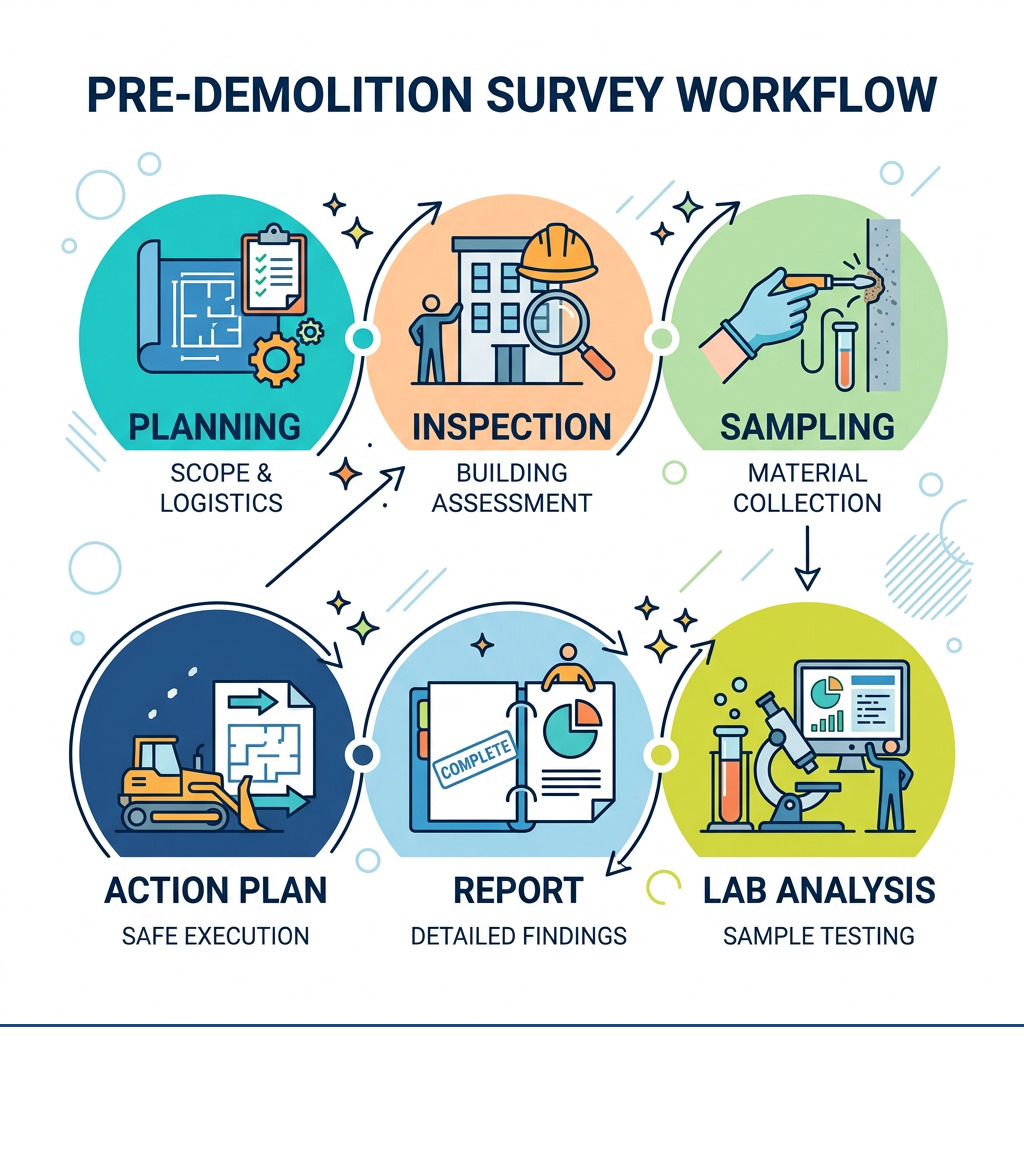
What is a pre demolition survey and Why is it Mandatory?
At its core, a pre demolition survey is a proactive threat assessment. Before the heavy machinery arrives, we need to know exactly what is inside the walls, under the floorboards, and wrapped around the pipes. The primary purpose is to ensure that when the building comes down, it doesn’t take the health of the neighborhood or the bank account of the developer with it.
Risk Assessment and Hidden Dangers
Buildings are like time capsules. Depending on when they were built, they might contain a “greatest hits” of industrial materials that we now know are dangerous. A pre demolition survey looks for these hidden dangers—things like friable asbestos that can become airborne the moment a wall is breached, or mercury switches in old HVAC systems. By identifying these risks early, we can create a plan to remove them safely before the main demolition begins.
Regulatory Compliance and Worker Protection
In New England, the rules are strict, and for good reason. Agencies like the EPA and OSHA, along with state-level departments in Massachusetts, Rhode Island, New Hampshire, Vermont, and Maine, mandate these inspections to protect workers. If you are a business owner or a municipality, you have a legal “duty of care.” This means you are responsible for ensuring a safe environment.
To help you understand what regulators look for, you can review What to Expect From an Environmental Compliance Inspection. While that specific guide is from Illinois, the federal standards it references apply across the board. Furthermore, understanding What is an Asbestos Survey? is the first step in meeting these compliance hurdles.
Cost Management
It might seem counterintuitive to spend money on a survey before spending money on demolition, but it is actually a cost-saving measure. If a demolition crew accidentally hits a pipe wrapped in asbestos, the entire site becomes a hazardous waste zone. The cleanup costs for cross-contamination—where hazardous dust gets into the soil or neighboring properties—are astronomical compared to the cost of a survey. A well-executed survey allows for accurate bidding and prevents “nasty surprises” that lead to change orders and project delays.
Key Components of a Thorough Inspection
A comprehensive pre demolition survey is much more than a guy with a clipboard walking through a room. It is a systematic, invasive process.

Identifying Hazardous Materials
We look for a variety of substances that require special handling:
- Asbestos: Found in over 3,000 different building products. You can learn more about these in our guide on Asbestos Containing Materials.
- Lead Paint: Common in almost any building in Boston, Providence, or Manchester built before 1978.
- PCBs (Polychlorinated Biphenyls): Often found in old fluorescent light ballasts and certain types of caulking.
- Mercury: Found in thermostats, silent switches, and high-intensity discharge lamps.
One of the most common questions we get is How to Tell if Insulation is Asbestos. The truth is, you can’t tell just by looking; it requires laboratory testing.
Friable vs. Non-Friable Asbestos
During the survey, we categorize materials to determine how they must be handled.
| Material Type | Description | Risk Level | Examples |
|---|---|---|---|
| Friable | Can be crumbled or reduced to powder by hand pressure when dry. | High | Pipe insulation, sprayed-on fireproofing, acoustic plaster. |
| Non-Friable | Bound in a solid matrix; cannot be easily crumbled. | Lower (until disturbed) | Vinyl floor tiles, roofing shingles, cement siding. |
Structural Stability and Utilities
Beyond chemicals, we assess the physical “bones” of the structure. Is the building leaning? Are there shared party walls with a neighbor in a dense area like Lowell or Worcester? We also verify utility terminations. You don’t want the wrecking ball hitting a live gas line. This includes checking public utilities (gas, electric, water) and private ones like septic tanks or heating oil USTs (Underground Storage Tanks).
Choosing the Right Type of pre demolition survey
Not every project requires the same level of intensity. We generally categorize surveys into three types:
- Presumptive Survey: We assume materials contain hazards based on the age of the building without taking many samples. This is rarely sufficient for full demolition but can be used for initial planning.
- Limited Sampling: Targeted at specific areas for minor renovations or “soft demos.”
- Full Access Sampling: This is the gold standard for demolition. It involves “destructive” testing—breaking into walls, lifting floors, and checking crawlspaces to ensure no stone is left unturned. This falls under our Asbestos Abatement / Testing services to ensure 100% certainty.
The Process of Conducting a pre demolition survey
The process follows a logical flow to ensure accuracy:
- Site Walkthrough: A visual inspection to map out “suspect” materials.
- Sampling: Physically collecting pieces of material (tiles, insulation, plaster) and air samples.
- Lab Analysis: Sending samples to a certified lab to confirm the presence and concentration of hazards.
- Formal Reporting: Creating a document that serves as a blueprint for the demolition crew.
- Action Planning: Based on the report, we help you decide what needs to be removed first. There are Five Reasons why professional testing is the only way to move forward safely.
Compliance, Permits, and Legal Consequences
Demolition is one of the most highly regulated activities in the construction industry. In New England, you aren’t just dealing with local town halls; you’re dealing with state and federal oversight.
EPA, OSHA, and State Notifications
Before a single brick is moved, most states require a notification period (often 10 working days). This gives regulators time to review your pre demolition survey and your plan for handling any hazards. If you’re looking for an example of how to prepare for these high-stakes reviews, you can see how other regions handle it in Preparing for an Ohio EPA Inspection. While the geography is different, the rigors of the EPA standards remain the same.
The Cost of Skipping the Survey
If you proceed with Demolition without a proper survey, the consequences are severe:
- Fines: Federal and state fines can reach tens of thousands of dollars per day.
- Legal Liability: If a worker or neighbor gets sick years down the road due to asbestos exposure, the lack of a survey is a massive legal liability.
- Soil Contamination: If lead paint or PCBs are ground into the dirt during demolition, the cost to remediate that soil can be higher than the value of the land itself.
Common Demolition Permits in New England
Depending on whether you are in Boston, Providence, or Nashua, you may need:
- Standard Demolition Permit: Issued by the local building department.
- Environmental Notification: Required by state environmental agencies (e.g., MassDEP).
- Utility Disconnect Permits: Proof that water, sewer, and electric are safely capped.
- Street Use/Sidewalk Closure Permits: If the demolition impacts public right-of-ways.
Frequently Asked Questions
How does a survey differ from a pre-bid walkthrough?
A pre-bid walkthrough is for contractors to see the site so they can give you a price. It is usually a visual-only “eyeball” test. A pre demolition survey is a technical, scientific document. It provides the detailed data that contractors need to give you an accurate price. Without the survey, contractors will often “bid high” to cover the risk of unknown hazards. When Hiring Contractors, always provide them with the survey report first.
Who is required to undertake these surveys?
Essentially, anyone responsible for the structure. This includes:
- Property Owners: Residential or commercial.
- Developers: Preparing a site for new construction.
- Municipalities: Dealing with abandoned or condemned buildings.
- Commercial Entities: Moving out of an old industrial space.
What are the risks of a poor-quality survey?
A “cheap” survey is often more expensive in the long run. If a surveyor misses a cache of asbestos-insulated pipes behind a basement wall, that material will be pulverized during demolition. This leads to cross-contamination, where hazardous fibers are spread across the entire site. This results in immediate project shutdowns, mandatory evacuations, and health hazards for everyone in the vicinity.
Conclusion
A pre demolition survey is the bedrock of a successful project. It transforms a building full of “unknowns” into a manageable, predictable project plan. By identifying asbestos, lead, PCBs, and structural risks early, you protect your workers, your timeline, and your bottom line.
At Banner Environmental Services, we bring over 25 years of experience to every site. As a WBE and DCAMM-certified company, our licensed team is intimately familiar with the specific regulatory landscapes of Massachusetts, Rhode Island, New Hampshire, Vermont, and Maine. Whether you’re in a historic neighborhood in Boston or an industrial park in Warwick, we ensure your project is fully compliant with OSHA and EPA standards.
Don’t leave your project to chance. Schedule your pre-demolition survey with us today and make sure the only thing that swings is the wrecking ball—not your project’s budget.