
What to Look for in a Mold Remediation Proposal (And Why It Matters)
A mold remediation proposal is a written document from a licensed contractor that outlines exactly how mold contamination will be assessed, contained, removed, and verified on your property. Here’s what a complete proposal should include at a glance:
- Scope of work – contaminated areas identified by square footage
- Moisture source identification – the root cause that must be fixed first
- Containment strategy – how mold will be isolated to prevent spread
- Remediation methods – specific techniques like HEPA vacuuming, wet wiping, or material removal
- PPE and safety requirements – protection for workers and occupants
- HVAC evaluation – whether the system needs shutdown or cleaning
- Clearance criteria – how you’ll know the job is truly done
- Cost breakdown – itemized labor, equipment, and disposal fees
- Timeline – from assessment through re-occupancy
Getting a proposal for mold work can feel overwhelming, especially when you’re already dealing with the stress of discovering contamination in your building. You might receive several bids that look nothing alike — different methods, vague descriptions, wildly different prices. How do you know which one to trust?
The reality is that not all mold remediation proposals are created equal. A poorly written proposal can lead to incomplete work, cross-contamination, failed clearance tests, and costs that spiral far beyond the original estimate. One property manager in Brooklyn, for example, faced over $20,000 in additional costs — including re-remediation and tenant relocation — after a contractor skipped the written plan entirely and spread mold throughout the building.
This guide breaks down every component of a professional proposal so you can evaluate what you’re being handed with confidence.
I’m Stephen Wenzel, Co-Owner and Executive Vice President of Banner Environmental Services, with over 25 years of hands-on experience in environmental remediation across Massachusetts, Rhode Island, and Greater New England. I’ve overseen hundreds of mold remediation proposal reviews and project executions, and I’ll walk you through exactly what separates a thorough, compliant proposal from one that puts your property — and your occupants — at risk.
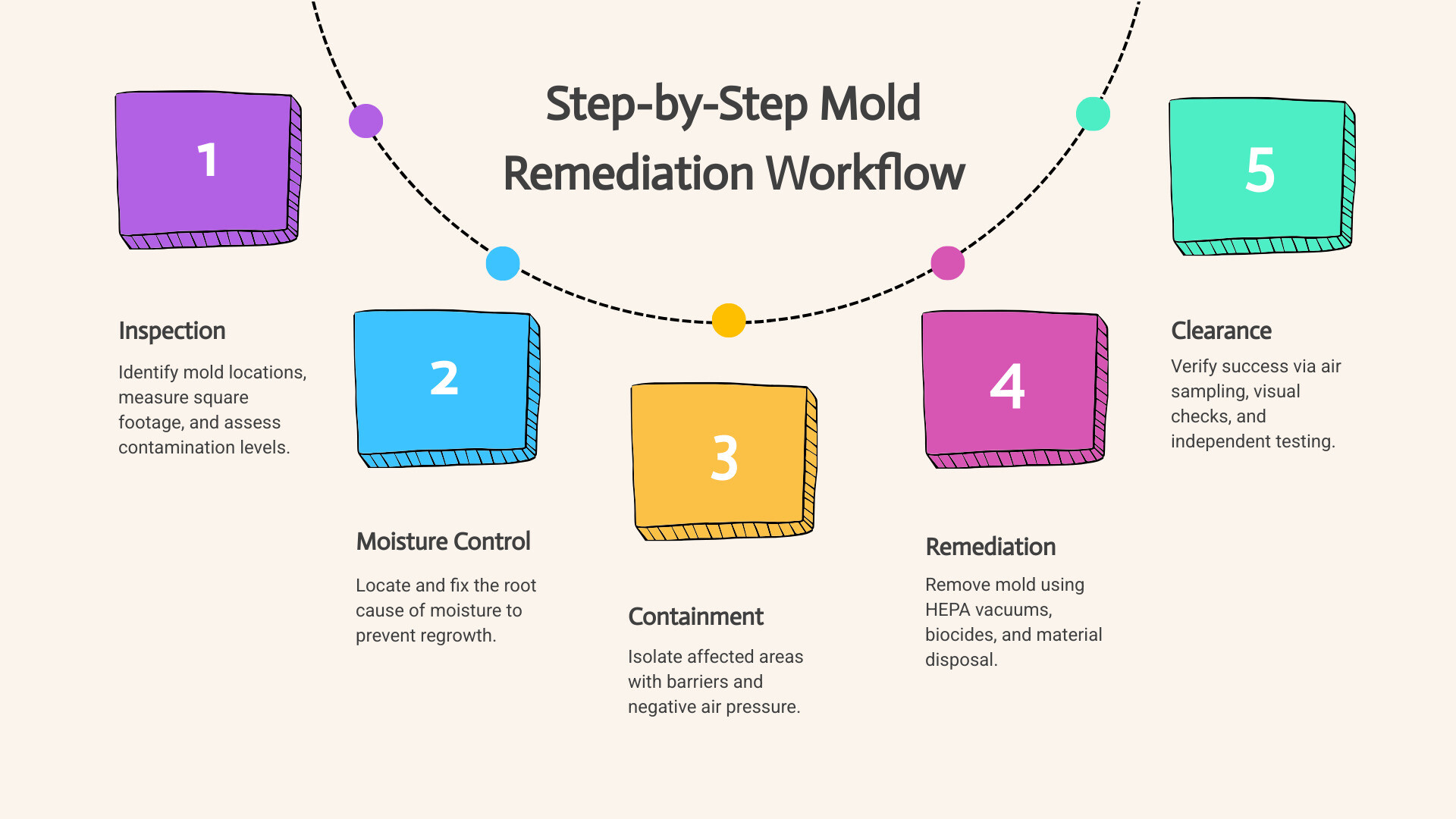
Anatomy of a Professional Mold Remediation Proposal
When we provide a mold remediation proposal, it serves as a roadmap for the entire project. It isn’t just a price tag; it’s a technical document designed to ensure the safety of your home or business. If a contractor hands you a one-page “estimate” that only says “remove mold,” run the other way.
A professional proposal must define the project scope clearly. This includes identifying the moisture source—because if you don’t fix the leak, the mold will be back before the ink on your check is dry. It should also set specific remediation goals, such as returning the indoor environment to a “normal fungal ecology.”
To help you understand the complexity of different projects, refer to the table below:
- Small: under 10 sq. ft. Typically involves basic PPE, targeted cleaning, and limited containment needs.
- Medium: 10 to 30 sq. ft. Usually calls for localized containment, HEPA air filtration, and respiratory protection.
- Large: 30 to 100 sq. ft. Often requires full containment, negative air pressure, and professional supervision.
- Extensive: over 100 sq. ft. Commonly involves advanced containment, decontamination areas, and more extensive PPE.
For a deeper look at how we identify these issues, explore our inspection and testing services.
Essential Documentation in a Mold Remediation Proposal
A comprehensive proposal should include site-specific details that prove the contractor has actually walked the property. We look for floor plans highlighting the affected areas and detailed assessment reports. In states like New York, and often following EPA guidelines, a written remediation plan is a legal necessity for larger projects. This documentation ensures that everyone—from the building owner to the field technicians—is on the same page regarding which walls are coming down and which vents are being sealed.
How to Structure Costs in a Mold Remediation Proposal
Transparency is key. A solid mold remediation proposal should feature itemized costs. You should see a breakdown of labor hours, the cost of material disposal (which often requires special handling), and equipment rental for items like industrial-grade dehumidifiers and HEPA air scrubbers. By itemizing these, you can compare bids fairly. If one contractor is 50% cheaper but doesn’t list “containment” or “HEPA vacuuming,” they are likely cutting corners that will cost you more in the long run.
Categorizing Scope: Size, Extent, and Site-Specifics
The first step in any proposal is determining the magnitude of the problem. We don’t just look at what’s visible on the surface; we investigate hidden mold behind drywall or under floorboards. This is especially critical in damp areas like basements. You can learn about basement mold remediation dangers to understand why these spaces require extra caution.
Assessing Contamination Size
We categorize mold growth based on contiguous square footage.
- Small areas (under 10 sq. ft.) are often manageable with standard cleaning protocols.
- Medium areas (10 to 30 sq. ft.) require more formal isolation.
- Large and Extensive growth (over 30 sq. ft.) triggers much stricter requirements for containment and worker safety.
Assessing the size correctly is vital because it determines the level of PPE and training required for the crew.
State-Specific Regulatory Compliance
While federal regulations are limited, state and local guidelines vary significantly across New England and neighboring areas. For instance, New York has a strict 10-square-foot rule where licensed professionals must be used. In Massachusetts and Rhode Island, we follow IICRC S520 standards to ensure compliance. Knowing these rules is part of our job, and your proposal should reflect the legal requirements of your specific location. You can find more health info on mold exposure from the CDC to understand why these regulations exist.
Technical Execution: Methods, Containment, and HVAC
The “how” of the project is just as important as the “where.” A professional mold remediation proposal will detail specific cleanup techniques. We don’t just “bleach” mold (which is often ineffective on porous surfaces); we physically remove it.
Methods often include:
- Wet Vacuuming: For extracting water from carpets or upholstery.
- HEPA Vacuuming: Using High-Efficiency Particulate Air filters to trap tiny spores.
- Damp Wiping: Using antimicrobial biocides to sanitize non-porous surfaces.
- Disposal: Bagging and removing contaminated porous materials like drywall or insulation.
For more details on these techniques, visit our mold remediation services page.
Containment Strategies by Project Size
Containment is what prevents a small mold problem in the bathroom from becoming a huge mold problem in the living room.
- Source Containment: Covering the moldy area directly.
- Local Isolation: Using plastic sheeting and zipper doors to seal off a room.
- Full-Scale Barriers: Creating “critical barriers” over all openings, including windows and doors.
- Pressure Differentials: Using HEPA-filtered exhaust fans to maintain negative air pressure, ensuring that air only flows into the work area, never out.
HVAC System Evaluation and Shutdown
Your HVAC system is the “lungs” of your building. If mold spores get into the ducts, they can be distributed everywhere. A professional proposal will address whether the HVAC system needs to be shut down during work and if the ducts require specialized cleaning. We often recommend system isolation and filter replacement as standard precautions to avoid cross-contamination.
Safety Standards and Worker Qualifications
Safety isn’t optional. At Banner Environmental, we prioritize the health of our team and your occupants. A proposal should explicitly state the PPE requirements. For small investigations, an N-95 respirator might suffice. For active remediation, our technicians wear full-face respirators, disposable Tyvek suits, and nitrile gloves.
We also ensure all projects comply with OSHA standards. You can find more info about asbestos and mold remediation safety on our site, as these two hazards often go hand-in-hand in older New England homes.
The Role of the Competent Person
Every project should be overseen by a “Competent Person”—a qualified professional capable of identifying hazards and authorized to take corrective action. This individual ensures that fit testing for respirators is up to date and that daily safety logs are maintained. Their expertise is what keeps a project on track and compliant.
Insurance and Liability Considerations
Never hire a contractor who cannot provide proof of insurance. A professional mold remediation proposal should come from a company carrying Pollution Occurrence Insurance, which specifically covers mold (standard general liability often excludes it). We also maintain workers’ compensation and all necessary state licenses. Our team adheres to the professional standards from IICRC, the gold standard in the restoration industry.
Verification and Clearance: Knowing the Job is Done
The job isn’t finished just because the visible mold is gone. The final phase of any project is Post-Remediation Verification (PRV). We believe in the philosophy: don’t just remove mold, remediate it. This means addressing the root cause and verifying the air quality.
Post-Remediation Verification (PRV)
Clearance involves a thorough visual inspection and, often, moisture mapping to ensure the area is dry. For larger projects, we recommend air and surface sampling analyzed by an independent third-party laboratory. This provides an unbiased confirmation that the spore counts are within acceptable limits. Only after a “passed clearance report” is issued should the containment be taken down and re-occupancy authorized.
Documentation and Final Project Logs
A professional contractor will provide you with a “close-out chamber” of documents. This includes:
- Waste Manifests: Proving materials were disposed of legally.
- Daily Progress Photos: Documenting the work behind the containment.
- Drying Logs: Showing that humidity levels were brought under control.
- Passed Clearance Reports: Your “clean bill of health” for the property.
Frequently Asked Questions about Mold Remediation Proposals
How much does a typical mold remediation project cost?
While every project is unique, the average mold remediation cost is roughly $2,500. Most residential projects fall between $1,500 and $6,500. For professional services, expect rates between $10 and $25 per square foot. Factors like accessibility (attics vs. basements) and the need for structural repairs (drywall replacement) will influence the final number.
When is a professional mold remediation proposal legally required?
In states with specific mold laws, like New York, a written proposal and licensed professional are required for any area over 10 square feet. Even where not legally mandated by the state, most insurance companies require a formal, written mold remediation proposal from a certified professional before they will cover a claim.
Can I perform mold remediation myself to save money?
If the affected area is very small (less than 10 square feet) and on a hard, non-porous surface, you may be able to handle it yourself. However, for anything larger, or if the mold is in your HVAC system or behind walls, DIY efforts often backfire. Without professional containment and HEPA filtration, you risk spreading millions of spores throughout your home, leading to much higher costs later.
Conclusion
At Banner Environmental Services, we understand that finding mold is stressful. That’s why we provide the most detailed, compliant, and transparent mold remediation proposal possible for our clients across New England. With over 25 years of experience, WBE/DCAMM certification, and a team that lives and works in your community—from Boston and Worcester to Providence and Manchester—we have the local expertise to handle your project right the first time.
We pride ourselves on OSHA/EPA compliance and a commitment to restoring your property to a safe, healthy state. Whether you are a homeowner in Franklin or a facility manager in a downtown office, we are here to help. Contact us for commercial mold remediation in Boston or anywhere in the New England area today.