
Is That Old Flooring Dangerous? How to Spot Asbestos Tile
What does asbestos tile look like? Here’s a quick visual summary:
| Feature | Typical Asbestos Tile Characteristics |
|---|---|
| Size | 9×9 inches, 12×12 inches, or 18×18 inches |
| Thickness | 1/8 inch or thinner — brittle and easy to snap |
| Surface | Slightly waxy or oily sheen, sometimes powdery |
| Colors | Cream, grey, pink, green, pastel hues, or marbled/speckled patterns |
| Aging signs | Yellow or brown discoloration, oily staining near edges, hairline cracks |
| Adhesive beneath | Thick black or dark brown tar-like mastic |
| Era | Most common in buildings built or renovated between the 1920s and 1980s |
Important: Visual clues can point you in the right direction — but they cannot confirm asbestos. Only lab testing can do that.
If your building was constructed or renovated before 1980, there’s a real chance some of those old floor tiles contain asbestos. Asbestos was mixed into vinyl and asphalt floor tiles for decades because it was durable, cheap, fire-resistant, and good at blocking sound. It wasn’t until health research caught up that manufacturers stopped using it.
The tricky part? Asbestos tiles look almost identical to regular old vinyl tiles. There’s no obvious warning label on the surface. The size, color, and condition of a tile can suggest asbestos — but they can’t confirm it.
That’s why knowing what to look for matters. It helps you decide whether to leave a floor alone, cover it safely, or call in a professional before a renovation turns into a hazardous materials incident.
I’m Stephen Wenzel, Co-Owner and Executive Vice President of Banner Environmental Services, and with over 25 years of experience in asbestos abatement and environmental remediation across New England, I’ve seen how often property owners are surprised to learn what asbestos tile looks like — and how common it still is beneath carpets, newer flooring, and drop ceilings. In this guide, I’ll walk you through exactly what to look for, where to look, and what to do next.
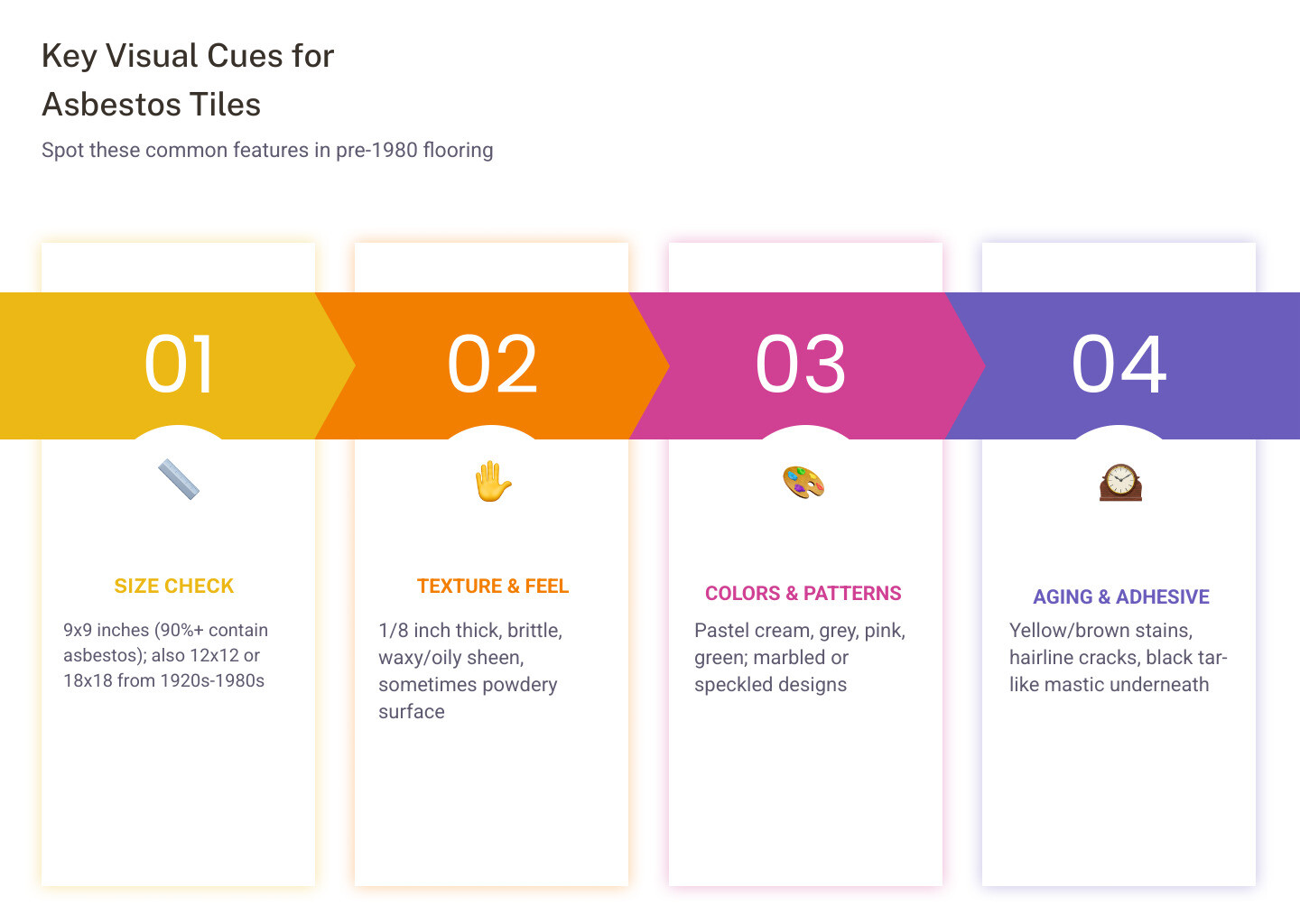
What Does Asbestos Tile Look Like?
When we walk into an older home in Boston or a commercial building in Providence, the first thing we look at is the dimensions of the flooring. While modern vinyl tiles are almost exclusively 12×12 inches or larger, older tiles often follow different “rules” of geometry.
The most famous indicator is the 9×9 inch square. If you find tiles that are exactly 9 inches by 9 inches, there is a very high probability—some estimates suggest over 90%—that they contain asbestos. These were the industry standard from the 1920s through the 1960s. However, don’t let 12×12 inch tiles fool you; while they became more common in the 1970s, many still contained asbestos until the mid-1980s.
Beyond size, the physical composition of the tile is a major giveaway. Asbestos floor tiles are typically quite thin, usually 1/16 inch, 3/32 inch, or 1/8 inch thick. Unlike modern luxury vinyl tile (LVT), which is flexible and rubbery, asbestos-containing tiles are extremely brittle. If you were to (carefully and with PPE) attempt to bend a loose piece, it wouldn’t flex—it would snap like a cracker.
Visually, these tiles often have a slightly waxy or oily surface sheen. This isn’t just because they’ve been polished for fifty years; it’s often due to the asphalt binders used in the manufacturing process. Over decades, these binders can degrade, leading to a texture that feels slightly “softer” or more “powdery” than modern stone or ceramic.
It is vital to remember that while these tiles are generally “non-friable” (meaning the asbestos fibers are locked inside a solid matrix), they become dangerous if they are sanded, sawed, or broken. Exposure to these microscopic fibers is a known carcinogen linked to asbestosis, lung cancer, and mesothelioma.
Common Colors and Patterns: What Does Asbestos Tile Look Like?
If you’re wondering what does asbestos tile look like in terms of style, think “mid-century functional.” Because these tiles were manufactured by mixing minerals and binders, the colors and patterns are often consistent all the way through the thickness of the tile.
Common visual styles include:
- Marbled Designs: These are perhaps the most recognizable. They feature swirls of contrasting colors—like cream with grey streaks or green with white veins—intended to mimic natural stone.
- Speckled or “Salt and Pepper” Patterns: Small dots of color scattered across a solid background.
- Pastel Hues: Many 1950s kitchens and bathrooms featured “Easter egg” colors, including light pink, mint green, sky blue, and buttery yellow.
- Solid Neutrals: Tan, beige, grey, and chocolate brown were staples for basement floors and commercial hallways.
In many New England schools and municipal buildings, you’ll see these patterns in high-traffic corridors. If you suspect your flooring matches these descriptions, it’s worth reviewing our guide on asbestos containing materials to see where else these patterns might hide.
Signs of Aging: What Does Asbestos Tile Look Like?
Asbestos tiles don’t always age gracefully. Because many were made with an asphalt base, they react to time and environment in specific ways.
One of the most telling signs of an asbestos-containing tile is oily discoloration. Over time, the oils in the asphalt binder can seep to the surface or migrate toward the edges of the tile. This creates a dark, grimy, or yellowish “halo” around the perimeter of each square. You might also notice dark stains that look like mold but don’t scrub away; this is often the black adhesive (mastic) underneath bleeding through hairline cracks in the tile.
Speaking of cracks, aging asbestos tiles often develop a “crazed” appearance—a network of tiny, fine cracks across the surface. Because the material is so brittle, building settling or heavy foot traffic causes it to fracture rather than dent.

Identifying Asbestos in Flooring, Ceilings, and Walls
To understand what does asbestos tile look like, we have to distinguish between the two main types of flooring:
- Vinyl-Asbestos Tile (VAT): These are the most common. They are colorful, slightly flexible when new, and usually contain 11% to 25% asbestos.
- Asphalt-Based Asbestos Tile (ABAT): These are older, usually darker (black, grey, or dark brown), and much more brittle.
In a typical 1950s renovation, you might find VAT in the kitchen and ABAT in the basement. But asbestos didn’t stop at the floor. It was also used extensively in ceiling tiles and even some wall applications.
| Feature | Asbestos Tile (VAT/ABAT) | Modern Vinyl Tile |
|---|---|---|
| Flexibility | Brittle; snaps easily | Flexible; can often be rolled or bent |
| Adhesive | Usually thick, black “mastic” | Clear, white, or light-colored glue |
| Wear Pattern | Waxy sheen; “oily” edge stains | Scratches or peels; no oil seepage |
| Fiber Presence | May show tiny white fibers when snapped | Smooth, plastic, or composite interior |
Asbestos Ceiling Tile Characteristics
Asbestos ceiling tiles are common in commercial spaces and basements across Massachusetts and Rhode Island. Unlike floor tiles, these are usually larger—standard sizes are 2×2 feet or 2×4 feet.
What does asbestos tile look like on a ceiling? Look for these “red flags”:
- Pinhole Markings: Many asbestos ceiling tiles have a distinct pattern of tiny, irregular “pinholes” or “dots” across the surface.
- Fissured Texture: A “craters of the moon” look with deep, irregular grooves.
- Light/Powdery Composition: If you touch a damaged corner, it may feel chalky or powdery. This is a higher risk because these tiles are often more “friable” than floor tiles, meaning they can release fibers more easily.
- Manufacturing Dates: If the tiles were installed before the mid-1980s, they should be treated as suspect.
If you have drop ceilings that match this description, it’s critical to get asbestos abatement testing before you start moving tiles to run new wiring or plumbing.
Asbestos Wall and Roof Tiles
While less common in residential interiors, asbestos was frequently used in wall tiles for “wet” areas like laundry rooms or commercial kitchens. These often look like standard ceramic tiles but are actually a vinyl-asbestos composite. They are typically held in place by the same thick, black adhesive found under floor tiles.
On the exterior, asbestos-cement roof tiles were a popular alternative to slate. They look like grey or reddish-brown stone and are incredibly hard and weather-resistant. However, as they age and weather, the cement binder can wear away, exposing the asbestos fibers to the wind and rain. The EPA has taken various actions to address these risks, particularly regarding the demolition of older structures.
The Role of Black Mastic and Adhesives
You can’t talk about what does asbestos tile look like without talking about what’s underneath it. Even if the tile itself is asbestos-free, the glue holding it down might not be.
From the 1920s through the 1980s, the “gold standard” for flooring adhesive was black mastic. This was a bitumen-based (asphalt) waterproof glue that almost always contained chrysotile asbestos.
What does black mastic look like?
- Color: Deep black or very dark brown.
- Texture: Thick, tar-like, and often ridges are visible from the notched trowel used to spread it.
- Residue: When tiles are pulled up, they often leave a “ghost” pattern of black adhesive on the concrete or wood subfloor.
If you pull up a modern carpet and find a black, sticky, or dried-out tar-like substance on the concrete, do not sand it. Sanding black mastic is one of the fastest ways to release high concentrations of asbestos fibers into the air. For those in the South Shore area, we offer specialized tile mastic removal in Quincy and surrounding towns to handle this specific hazard safely.
Why Visual Identification is Not Enough
We’ve spent a lot of time describing what asbestos tile looks like, but we have to be honest: you can never be 100% sure just by looking.
Asbestos fibers are microscopic—about 1,200 times thinner than a human hair. You cannot see them with the naked eye. Furthermore, many non-asbestos tiles were manufactured to look exactly like the popular asbestos styles of the day.
The only way to confirm the presence of asbestos is through laboratory analysis, typically using Polarized Light Microscopy (PLM). A professional inspector will take a “bulk sample”—a small piece of the tile and the adhesive—and examine it under a high-powered microscope to identify the specific type and percentage of asbestos minerals present.
When to Suspect Asbestos
While you shouldn’t panic, you should be highly suspicious if:
- Your home was built before 1980 (the “Golden Era” of asbestos).
- You see 9×9 inch tiles or 12×12 inch tiles with black adhesive.
- The tiles are cracking, peeling, or turning into a powdery mess.
- You are planning a renovation that involves “disturbing” the floor (scraping, sanding, or demolition).
Before you swing a sledgehammer, it is always safer to conduct a professional asbestos survey. This is especially true in commercial settings or schools, where legal compliance is strictly enforced.
Frequently Asked Questions about Asbestos Tiles
Can you tell if tiles contain asbestos just by looking?
No. While the “9-inch rule” and the presence of black mastic are very strong indicators, they are not definitive. Some early non-asbestos tiles were made in 9×9 sizes, and some late-era asbestos tiles were made in 12×12 sizes. Professional lab testing is the only way to know for sure.
What should you do if you find damaged asbestos tiles?
If the tiles are in good condition and won’t be disturbed, the EPA often recommends leaving them alone or “encapsulating” them (covering them with new, non-asbestos flooring). However, if they are cracked, crumbling, or in a high-traffic area where they are being pulverized, you should:
- Seal off the area to prevent foot traffic.
- Avoid vacuuming, sweeping, or sanding the debris.
- Call a licensed abatement professional to assess the damage.
Are 12×12 tiles always asbestos-free?
Absolutely not. While 12×12 tiles became the standard as asbestos was being phased out, they were still produced with asbestos well into the late 1970s and early 1980s. Furthermore, even if a 12×12 vinyl tile is asbestos-free, it may have been installed using asbestos-containing black mastic. Always check both the tile and the glue.
Conclusion
Identifying what asbestos tile looks like is the first step in keeping your home or business safe. Whether it’s the classic 9×9 marbled square in a basement or the pin-holed ceiling tiles in an office, these materials are a lingering legacy of 20th-century construction.
At Banner Environmental Services, we’ve spent over a quarter-century helping New Englanders navigate these hazards. From asbestos floor tile abatement in Brighton to large-scale commercial projects, our team ensures every job is done with total OSHA and EPA compliance.
If you’re standing in a kitchen in Worcester or a basement in Nashua wondering about your floor, don’t guess. Our licensed professionals are ready to provide the clarity you need. Whether you need a simple test or a full-scale removal, we’re here to ensure your renovation is safe, legal, and fiber-free.
For more information or to schedule an inspection, explore our services regarding asbestos abatement and testing today.